

ISSN 1004-5759 CN 62-1105/S
草业学报 ›› 2026, Vol. 35 ›› Issue (11): 170-183.DOI: 10.11686/cyxb2025466
• 研究论文 • 上一篇
李怡1,2( ), 多晶1, 刘宇昊1, 刘芳1, 刘世亮1, 介晓磊1, 赵颖1()
收稿日期:2025-11-17
修回日期:2025-12-25
出版日期:2026-11-20
发布日期:2026-10-12
通讯作者:
赵颖
作者简介:Corresponding author. E-mail: zhaoyingspring@163.com基金资助:
Yi LI1,2(), Jing DUO1, Yu-hao LIU1, Fang LIU1, Shi-liang LIU1, Xiao-lei JIE1, Ying ZHAO1()
Received:2025-11-17
Revised:2025-12-25
Online:2026-11-20
Published:2026-10-12
Contact:
Ying ZHAO
摘要:
针对石灰性镉(Cd)污染土壤修复效率偏低的问题,通过田间试验探究了木醋液对土壤Cd形态转化及黑麦草Cd转运富集的影响。试验设置4个木醋液浓度处理:不添加(T0)、稀释400倍(T1)、稀释200倍(T2)和稀释100倍(T3),分析了两茬黑麦草的生长状况、Cd富集与转运特性,以及根际土壤的理化性质和Cd形态变化。结果显示,施加木醋液后黑麦草两茬地上部生物量分别提高48.98%~93.74%和8.81%~210.61%(P<0.05),黑麦草地上部富集系数和转运系数显著增加(P<0.05),两茬黑麦草地上部Cd积累量较对照处理显著提高,第1茬黑麦草地上部Cd积累量最高为45.53 g·hm-2,第2茬仅为16.68 g·hm-2。两茬收割后施加木醋液处理土壤pH分别下降0.07~0.13、0.15~0.20个单位,土壤脲酶和蔗糖酶活性较T0处理(清水对照)分别提高72.73%~136.36%和23.19%~68.73%,土壤Cd含量较种植前分别下降0.01~0.34 mg·kg-1(第1茬)和0.20~0.49 mg·kg-1(第2茬),第2茬T3处理(木醋液稀释100倍)土壤Cd含量最低,为1.36 mg·kg-1,与第1茬T0处理相比降低31.31%。因此,木醋液通过活化土壤环境、促进黑麦草生长并强化Cd吸收转运,能有效提升黑麦草对重金属Cd污染农田土壤的修复效率。
李怡, 多晶, 刘宇昊, 刘芳, 刘世亮, 介晓磊, 赵颖. 木醋液对土壤镉形态转化及黑麦草镉转运富集的影响[J]. 草业学报, 2026, 35(11): 170-183.
Yi LI, Jing DUO, Yu-hao LIU, Fang LIU, Shi-liang LIU, Xiao-lei JIE, Ying ZHAO. Effects of wood vinegar on soil cadmium morphological transformation and cadmium transport and bioaccumulation in ryegrass[J]. Acta Prataculturae Sinica, 2026, 35(11): 170-183.
项目 Item | pH | 全镉 Total cadmium (mg·kg-1) | 有机质 Organic matter (g·kg-1) | 碱解氮 Alkali-hydrolyzable nitrogen (mg·kg-1) | 速效磷 Available phosphorus (mg·kg-1) | 速效钾 Available potassium (mg·kg-1) |
|---|---|---|---|---|---|---|
| 土壤Soil | 7.79 | 2.06 | 9.96 | 9.75 | 23.45 | 354.67 |
表1 土壤基本理化性质
Table 1 Basic physical and chemical properties of soil
项目 Item | pH | 全镉 Total cadmium (mg·kg-1) | 有机质 Organic matter (g·kg-1) | 碱解氮 Alkali-hydrolyzable nitrogen (mg·kg-1) | 速效磷 Available phosphorus (mg·kg-1) | 速效钾 Available potassium (mg·kg-1) |
|---|---|---|---|---|---|---|
| 土壤Soil | 7.79 | 2.06 | 9.96 | 9.75 | 23.45 | 354.67 |
项目 Item | pH | 电导率 Electrical conductivity (mS·cm-1) | 有机质 Organic matter (g·kg-1) | 全氮 Total nitrogen (g·kg-1) | 全磷 Total phosphorus (g·kg-1) | 全钾 Total potassium (g·kg-1) |
|---|---|---|---|---|---|---|
| 木醋液Wood vinegar | 4.18 | 3.50 | 57.75 | 2.69 | 0.81 | 0.09 |
表2 木醋液基本理化性质
Table 2 Basic physical and chemical properties of wood vinegar
项目 Item | pH | 电导率 Electrical conductivity (mS·cm-1) | 有机质 Organic matter (g·kg-1) | 全氮 Total nitrogen (g·kg-1) | 全磷 Total phosphorus (g·kg-1) | 全钾 Total potassium (g·kg-1) |
|---|---|---|---|---|---|---|
| 木醋液Wood vinegar | 4.18 | 3.50 | 57.75 | 2.69 | 0.81 | 0.09 |
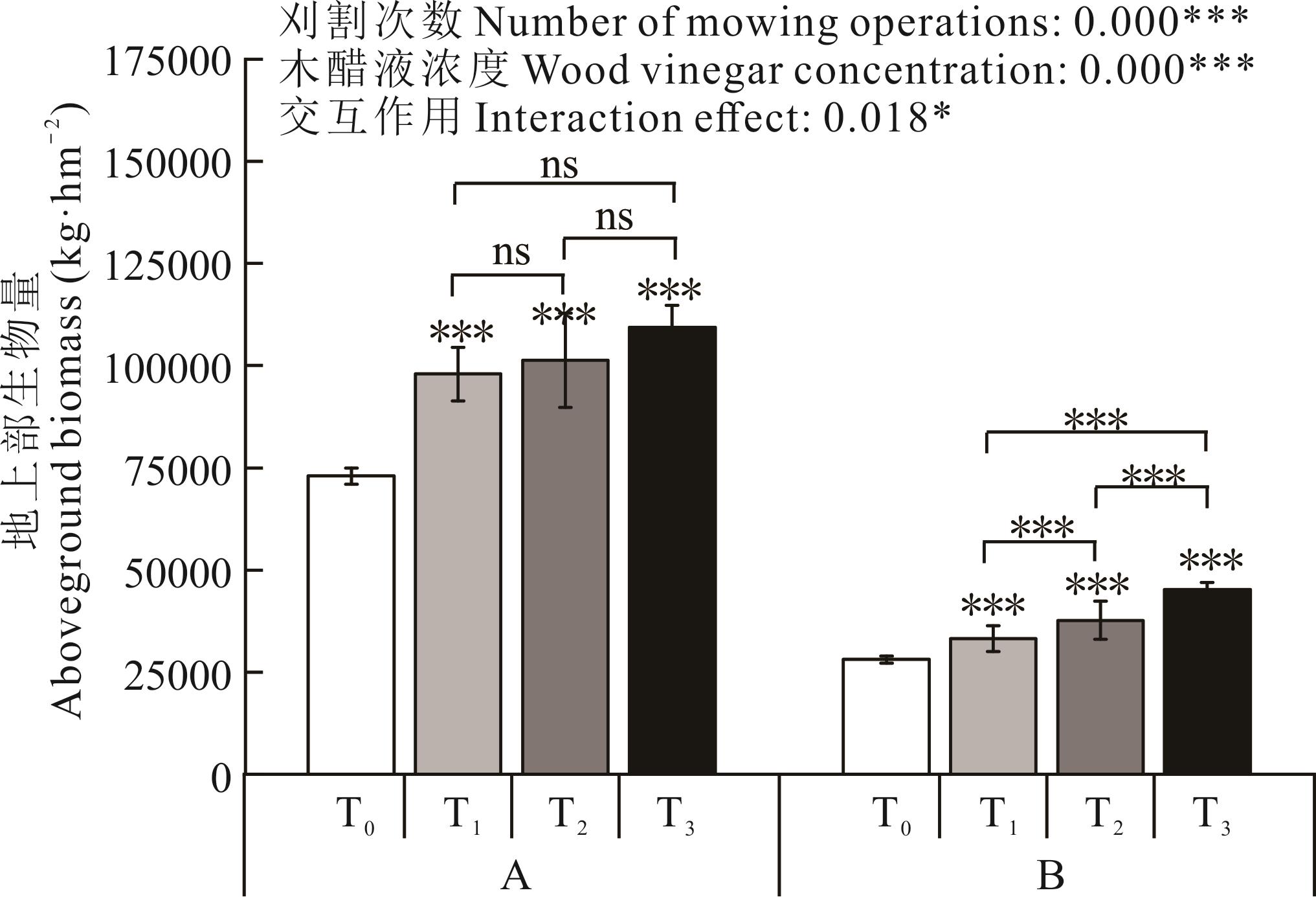
图1 不同木醋液浓度处理对黑麦草地上部生物量的影响*: 0.01<P<0.05; **: 0.001<P<0.01; ***: P<0.001; ns: 差异不显著No significant difference; A: 第1茬First harvest; B: 第2茬Second harvest. 下同The same below.
Fig.1 Effects of different wood vinegar concentrations on aboveground biomass of ryegrass
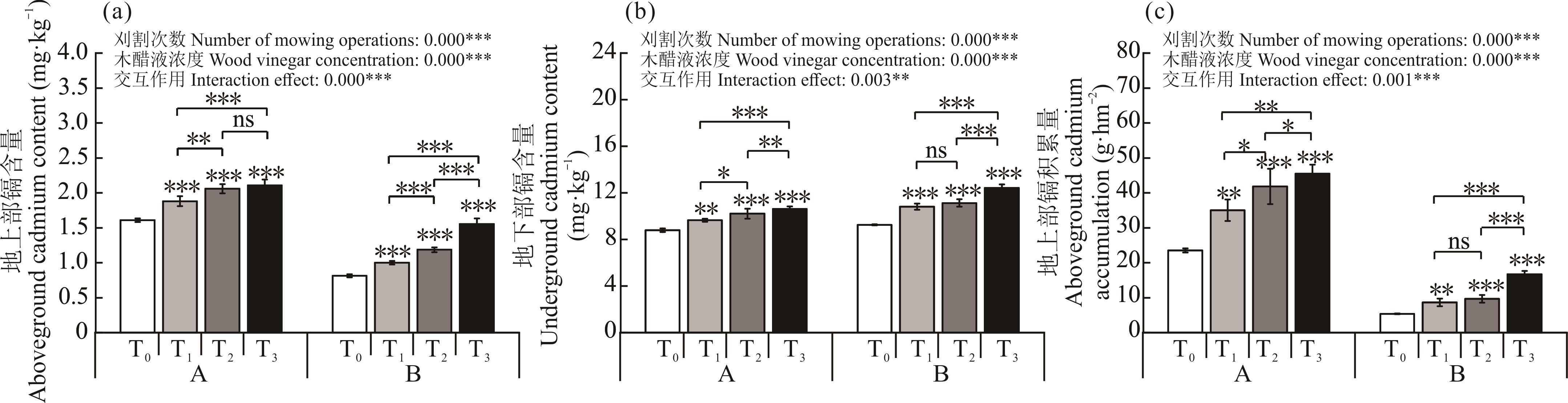
图2 不同木醋液浓度对黑麦草地上与地下部Cd含量以及积累量的影响
Fig.2 Effects of different wood vinegar concentrations on Cd content and accumulation in the aboveground and underground parts of ryegrass
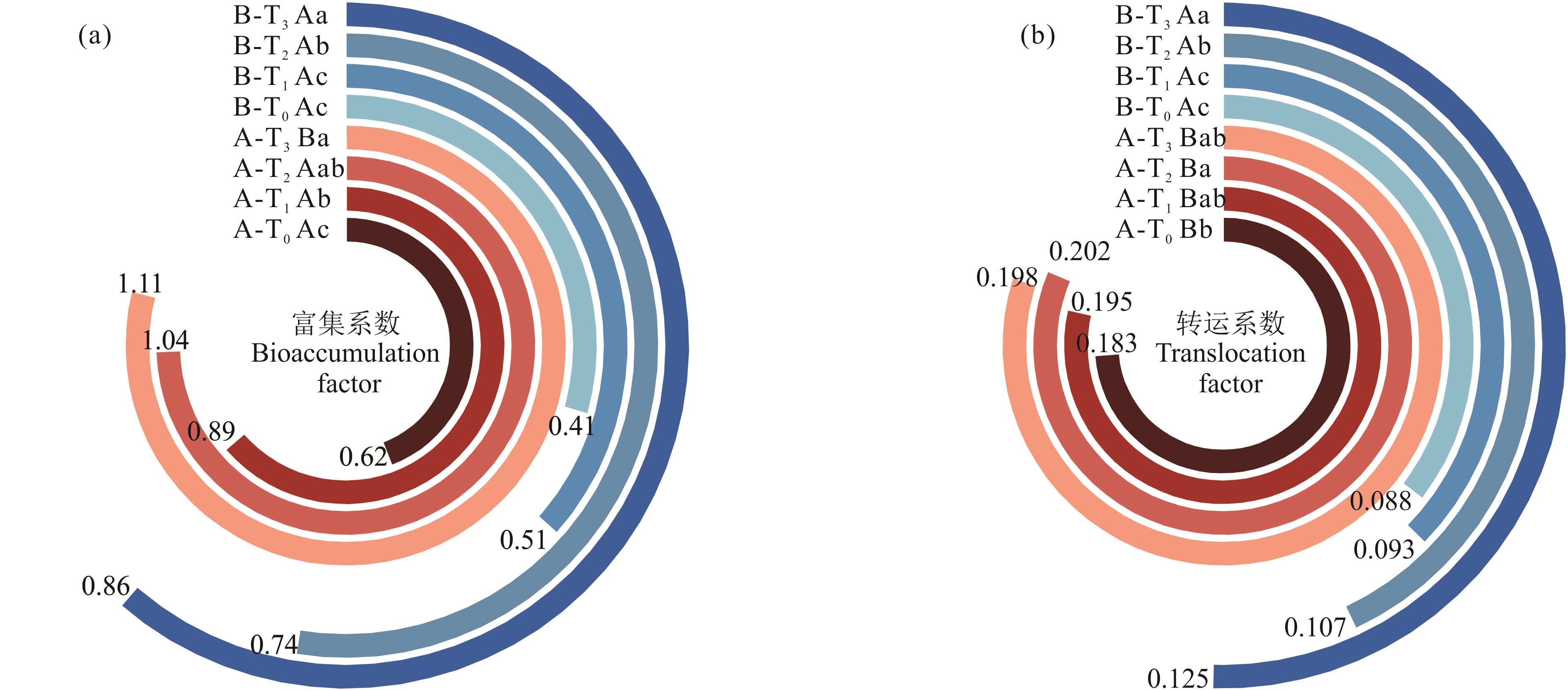
图3 不同木醋液浓度对黑麦草地上部Cd富集系数和转运系数的影响不同大写字母表示不同茬次相同施用浓度间差异显著(P<0.05),不同小写字母表示同一茬次处理间差异显著(P<0.05)。Different capital letters indicate significant differences between different growth stages with the same application concentrations (P<0.05), while different lowercase letters indicate significant differences among treatments within the same growth stage (P<0.05).
Fig.3 Effects of different wood vinegar concentrations on Cd bioaccumulation factor and translocation factor in the aboveground part of ryegrass

图4 不同木醋液浓度联合黑麦草对土壤pH和脲酶、过氧化氢酶、蔗糖酶活性的影响
Fig.4 Effects of different wood vinegar concentrations combined with ryegrass on soil pH, urease, catalase, and sucrase activities

图5 不同木醋液浓度联合黑麦草对土壤Cd含量及赋存形态的影响
Fig.5 Effects of different wood vinegar concentrations combined with ryegrass on soil Cd content and speciation
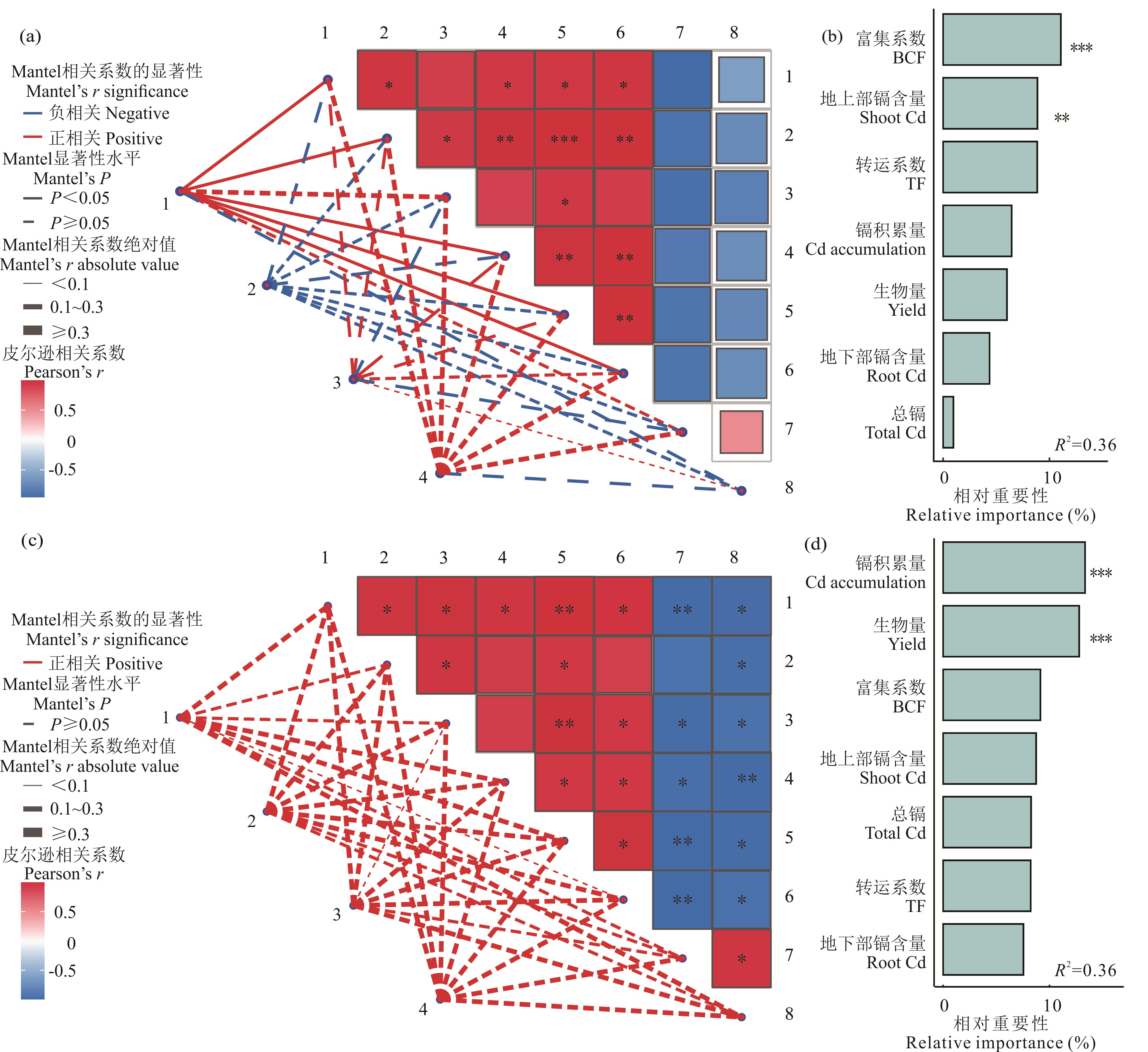
图6 不同木醋液浓度处理下两茬黑麦草各指标之间的Mantel试验分析以及随机森林模型预测影响土壤有效态Cd的关键因子(a)和(c)为第1和第2茬黑麦草各指标之间的Mantel试验分析,(b)和(d)为第1和第2茬随机森林模型预测影响黑麦草有效态镉的关键因子。(a)和(c)图中,环境因子1: pH; 2: 过氧化氢酶; 3: 脲酶; 4: 蔗糖酶;物种因子1: 生物量; 2: 富集系数; 3: 转运系数; 4: 地下部Cd含量; 5: 地上部Cd含量; 6: Cd积累量; 7: 有效态Cd; 8: 总Cd。(a) and (c) present Mantel test analyses of indicators between the first and second ryegrass crops, while (b) and (d) demonstrate key factors predicted by the random forest model for effective Cd in ryegrass. In figure (a) and (c), environmental factors are: 1: pH; 2: Catalase (Soil CAT); 3: Urease (Soil UE); 4: Sucrase (Soil SC); Species factors are: 1: Biomass (Yield); 2: Bioaccumulation factor (BCF); 3: Translocation factor (TF); 4: Root Cd content (Root Cd); 5: Shoot Cd content (Shoot Cd); 6: Cd accumulation amount (Cd accumulation); 7: Effective Cd (DTPA Cd); 8: Total Cd content (Total Cd).
Fig.6 Mantel test analysis of various indicators in two harvests of ryegrass under different wood vinegar concentrations, along with key factors affecting soil available Cd identified by the random forest model
| [1] | Yu Q Y, Li W Y, Zhang N, et al. Present pollution status and safe utilization technologies of heavy metal-polluted farmland soil: a review. Soils, 2024, 56(2): 229-241. |
| 余琼阳, 李婉怡, 张宁, 等. 农田土壤重金属污染现状与安全利用技术研究进展. 土壤, 2024, 56(2): 229-241. | |
| [2] | Setia R, Dhaliwal S S, Singh R, et al. Ecological and human health risk assessment of metals in soils and wheat along Sutlej river(India). Chemosphere, 2023, 312(Part 1): 137331. |
| [3] | Baltas H, Sirin M, Gökbayrak E, et al. A case study on pollution and a human health risk assessment of heavy metals in agricultural soils around Sinop Province, Turkey. Chemosphere, 2020, 241(3/4): 125015. |
| [4] | Ministry of Environmental Protection of the People’s Republic of China, Ministry of Land and Resources of the People’s Republic of China. Report on the national general survey of soil contamination. China Environmental Protection Industry, 2014, 20(5): 10-11. |
| 环境保护部, 国土资源部.全国土壤污染状况调查公报. 中国环保产业, 2014, 20(5): 10-11. | |
| [5] | Chen S B, Wang M, Li S S, et al. Currentstatus of and discussion on farmland heavy metal pollution prevention in China. Earth Science Frontiers, 2019, 26(6): 35-41. |
| 陈世宝, 王萌, 李杉杉, 等. 中国农田土壤重金属污染防治现状与问题思考. 地学前缘, 2019, 26(6): 35-41. | |
| [6] | Zheng S N, Wang Q, Yuan Y Z, et al. Human health risk assessment of heavy metals in soil and food crops in the Pearl River Delta urban agglomeration of China. Food Chemistry, 2020, 316: 126213. |
| [7] | Gong B, Wang X P, Ying R R, et al. Impact of soil moisture on the bioavailability and ecotoxicity of heavy metals. Asian Journal of Ecotoxicology, 2025, 20(1): 48-61. |
| 龚冰, 王徐鹏, 应蓉蓉, 等. 土壤湿度对重金属污染物的生物有效性和生态毒性影响. 生态毒理学报, 2025, 20(1): 48-61. | |
| [8] | Song P P, Xu D, Yue J Y, et al. Recent advances in soil remediation technology for heavy metal contaminated sites: A critical review. Science of the Total Environment, 2022, 838(11): 156417. |
| [9] | Ghuge S A, Nikalje G C, Kadam U S, et al. Comprehensive mechanisms of heavy metal toxicity in plants, detoxify cation, and remediation. Journal of Hazardous Materials, 2023, 450(9): 131039. |
| [10] | Zhang L H, Bai J J, Tian R Y, et al. Cadmium remediation strategies in alkaline arable soils in Northern China: current status and challenges. Acta Pedologica Sinica, 2024, 61(2): 348-360. |
| 张力浩, 白姣杰, 田瑞云, 等. 中国北方碱性农田土壤镉污染修复:现状与挑战. 土壤学报, 2024, 61(2): 348-360. | |
| [11] | Zhao X F, Lei M, Chen T B. Species, habitat characteristics, and screening suggestions of cadmium hyperaccumulators in China. Environmental Science, 2023, 44(5): 2786-2798. |
| 赵晓峰, 雷梅, 陈同斌. 中国镉超富集植物的物种、生境特征和筛选建议. 环境科学, 2023, 44(5): 2786-2798. | |
| [12] | Liu Y W, Zhou J J, Sun D L, et al. Polyaspartic acid assisted-phytoremediation of cadmium-contaminated farmland: phytoextraction efficiency, soil quality, and rhizosphere microbial community. Science of the Total Environment, 2023, 862:160736. |
| [13] | Yang J S, Luo X S, Zhang X Y, et al. Investigation of Cd enrichment capacity and remediation potential of wild plants including Ammannia baccifera L. in Cd-contaminated farmland soil. Journal of Agro-Environment Science, 2023, 42(8): 1739-1747. |
| 杨金山, 罗小三, 张欣悦, 等. 污染农田水苋菜等野生植物镉富集能力和修复潜力调查. 农业环境科学学报, 2023, 42(8): 1739-1747. | |
| [14] | Zhou Z Q. Phytoextraction of cadmium in napier grass (Pennisetum purpureum Schumach) under field conditions. Fuzhou: Fujian Agriculture and Forestry University, 2020. |
| 周志强. 象草对镉污染土壤的田间植物提取修复效果研究. 福州: 福建农林大学, 2020. | |
| [15] | Li X M, Li J B, Song G L, et al. Cadmium tolerance and absorption characteristic of herbaceous plants. Pratacultural Science, 2018, 35(4): 760-770. |
| 李希铭, 李金波, 宋桂龙, 等. 35份草本植物镉吸收与富集特征比较. 草业科学, 2018, 35(4): 760-770. | |
| [16] | Chen X Y. Phytoremediation of heavy metal contaminated soils with mobilizing amendments. Zhengzhou: Henan University of Technology, 2021. |
| 陈小亚. 活化剂结合植物修复重金属污染土壤的研究. 郑州: 河南工业大学, 2021. | |
| [17] | Li J J. Screening of cadmium hyper-enriched plants and their combination with chelating agents for remediation of cadmium-contaminated soil. Mianyang: Southwest University of Science and Technology, 2024. |
| 李加驹. 镉超富集植物的筛选及其与螯合剂联合修复镉污染土壤的研究. 绵阳: 西南科技大学, 2024. | |
| [18] | Wu D M, Yu X L, Lai M L, et al. Diversified effects of coplanting landscape plants on heavy metals pollution remediation in urban soil amended with sewage sludge. Journal of Hazardous Materials, 2021, 403: 123855. |
| [19] | Zhou H Y, Shen Y, Zhang N M, et al. Wood fiber biomass pyrolysis solution as a potential tool for plant disease management: A review. Heliyon, 2024, 10(3): e25509. |
| [20] | Shen S W, Zhang D D, Wang M G, et al. Effects of combined application of wood vinegar-acidified biochar and nitrogen on active nitrogen and ammonia volatilization in saline soil. Environmental Science, 2022, 43(5): 2779-2787. |
| 申书伟, 张丹丹, 王敏鸽, 等. 木醋液酸化生物炭与氮素配施对盐渍土壤活性氮及氨挥发的影响. 环境科学, 2022, 43(5): 2779-2787. | |
| [21] | Wu M M. Study on the remediation effect of wood vinegar/ryegrass combination on soil heavy metal cadmium. Zhengzhou: Henan Agricultural University, 2023. |
| 吴苗苗. 木醋液/黑麦草联合对土壤重金属Cd的修复效果研究. 郑州: 河南农业大学, 2023. | |
| [22] | Kumar S, Rahman M, Bouket A C, et al. Unravelling the multifarious role of wood vinegar made from waste biomass in plant growth promotion, biotic stress tolerance, and sustainable agriculture. Journal of Analytical and Applied Pyrolysis, 2025, 185(1): 106851. |
| [23] | Yang W H, Wang S S, Ni W Z, et al. Enhanced Cd-Zn-Pb-contaminated soil phytoextraction by Sedum alfredii and the rhizosphere bacterial community structure and function by applying organic amendments. Plant and Soil, 2019, 444(1/2): 101-118. |
| [24] | Fang Z G, Xie J T, Yang Q, et al. Role and mechanism of low molecular-weight-organic acids in enhanced phytoremediation of heavy metal contaminated soil. Environmental Science, 2022, 43(10): 4669-4678. |
| 方治国, 谢俊婷, 杨青, 等. 低分子有机酸强化植物修复重金属污染土壤的作用与机制. 环境科学, 2022, 43(10): 4669-4678. | |
| [25] | Benzon H R L, Venecio Jr U, Lee S C. Pyroligneous acid influenced the bioavailability of heavy metals in contaminated paddy soil. Journal of Ecological Engineering, 2025, 26(9): 354-369. |
| [26] | Li F Z, Zhang Y P, Hao S F, et al. Leaching behaviour and enhanced phytoextraction of additives for cadmium-contaminated soil by Pennisetum sp. Bulletin of Environmental Contamination and Toxicology, 2020, 104(5): 658-667. |
| [27] | Bao S D. Soil and agricultural chemistry analysis. Beijing: China Agriculture Press, 2000: 14-168. |
| 鲍士旦. 土壤农化分析. 北京: 中国农业出版社, 2000: 14-168. | |
| [28] | Zhu L N. Screening of winter wheat cultivars with low cadmium accumulation and differences in cadmium accumulation mechanism. Zhengzhou: Henan Agricultural University, 2021. |
| 朱利楠. 冬小麦镉低积累品种筛选及镉积累机制差异. 郑州: 河南农业大学, 2021. | |
| [29] | Tessier A, Campbell P G C, Bisson M. Sequential extraction procedure for the speciation of particulate trace metals. Analytical Chemistry, 1979, 51(7): 844-851. |
| [30] | Guan S Y. Soil enzymes and their research methods. Beijing: Agricultural Press, 1986: 294-302. |
| 关松荫. 土壤酶及其研究法. 北京: 农业出版社, 1986: 294-302. | |
| [31] | Duo J, Ye J R, Yang D X, et al. Effect of wood vinegar on cadmium enrichment and transport of Gramineous crops in Cd-contaminated farmland. Environmental Science, 2025, 46(4): 2571-2579. |
| 多晶, 叶佳润, 杨东霞, 等. 木醋液对镉污染农田禾本科作物富集转运Cd效应影响. 环境科学, 2025, 46(4): 2571-2579. | |
| [32] | Geng K, Mei D Q Z, Jiang M Y, et al. Effects of foliar spraying of wood vinegar on yield and quality of vegetables. Soil and Fertilizer Sciences in China, 2023(9): 160-168. |
| 耿坤, 梅朵曲珍, 蒋梦圆, 等. 叶面喷施木醋液对蔬菜产量及品质的影响. 中国土壤与肥料, 2023(9): 160-168. | |
| [33] | Zhang L D, Huo P J, Liang J M, et al. Research progress on preparation process and synergistic technology of biomass-based wood vinegar. Journal of Forestry Engineering, 2023, 8(5): 27-36. |
| 张立丹, 霍鹏举, 梁嘉敏, 等. 生物质基木醋液的制备工艺和增效技术研究进展. 林业工程学报, 2023, 8(5): 27-36. | |
| [34] | Luo X X, Wang Z Y, Meki K, et al. Effect of co-application of wood vinegar and biochar on seed germination and seedling growth. Journal of Soils and Sediments, 2019, 19(12): 3934-3944. |
| [35] | Liu Q Q, Wu Q G, Zhou J, et al. Effects of foliar spraying of ZnO and MnO2 nanoparticles on uptake and translocation of Cd, Zn and Mn in wheat. Soil, 2025, 57(2): 376-386. |
| 刘奇奇, 吴求刚, 周静, 等. 叶面喷施纳米氧化锌和二氧化锰对小麦镉锌锰吸收和转运的影响. 土壤, 2025, 57(2): 376-386. | |
| [36] | Wang P, Chen H P, Kopitke P M, et al. Cadmium contamination in agricultural soils of China and the impact on food safety. Environmental Pollution, 2019, 249(12): 1038-1048. |
| [37] | Strasdeit H, Duhme A K, Kneer R, et al. Evidence for discrete Cd (SCys)4 units in cadmium phytochelatin complexes from EXAFS spectroscopy. Journal of the Chemical Society, Chemical Communications, 1991(16): 1129-1130. |
| [38] | Luo X M, Qian J C, Wang K, et al. Research progress on role of low molecular weight organic acids in phytoremediation of heavy metal contaminated soil. Shandong Agricultural Sciences, 2025, 57(5): 171-180. |
| 罗晓萌, 钱建财, 王锴, 等. 低分子量有机酸在植物修复土壤重金属污染中的作用研究进展. 山东农业科学, 2025, 57(5): 171-180. | |
| [39] | Zhao F J, Ma Y, Zhu Y G, et al. Soil contamination in China: current status and mitigation strategies. Environmental Science & Technology, 2015, 49(2): 750-759. |
| [40] | Ministry of Agriculture and Rural Affairs of the People’s Republic of China. Hygienical standard for feeds: GB 13078-2017. Animal Agriculture, 2018(1): 16-24. |
| 中华人民共和国农业农村部. 饲料卫生标准: GB 13078-2017. 畜牧产业, 2018(1): 16-24. | |
| [41] | Han H J, Yu B B. Effects of biochar and wood vinegar on soil characteristics of moderate saline soil. Soil and Fertilizer Sciences in China, 2026(1): 22-29. |
| 韩红杰, 于贝贝. 生物炭与木醋液对中度盐土土壤特性的影响. 中国土壤与肥料, 2026(1): 22-29. | |
| [42] | Han Y, Qiao D M, Qi X B, et al. Effects of oxalic acid on oil sunflower biomass, enzyme activity, and the Cd speciation of Cd-polluted soils. Journal of Agro-Environment Science, 2020, 39(9): 1964-1973. |
| 韩洋, 乔冬梅, 齐学斌, 等. 草酸对镉污染土壤油葵生物量及土壤酶活性和镉形态的影响. 农业环境科学学报, 2020, 39(9): 1964-1973. | |
| [43] | Lu H F, Qiao D M, Qi X B, et al. Effects of exogenous organic acids on soil pH, enzyme activity, and cadmium migration and transformation. Journal of Agro-Environment Science, 2020, 39(3): 542-553. |
| 陆红飞, 乔冬梅, 齐学斌, 等. 外源有机酸对土壤pH值、酶活性和Cd迁移转化的影响. 农业环境科学学报, 2020, 39(3): 542-553. | |
| [44] | Du J J, Hou F, Zhou Q X. Response of soil enzyme activity and soil bacterial community to PCB dissipation across different soils. Chemosphere, 2021, 283(12): 131229. |
| [45] | Yan Q, Xie J T, Liu H J, et al. The addition of exogenous low-molecular-weight organic acids improved phytoremediation by Bidens pilosa L. in Cd-contaminated soil. Environmental Science and Pollution Research, 2022, 29(51): 76766-76781. |
| [46] | Ma H, Li X D, Hou S Y, et al. The activation and extraction systems using organic acids and Lentinus edodes to remediate cadmium contaminated soil. Environmental Pollution, 2019, 255(2): 113252. |
| [47] | Chen Q, Zhang X Y, Huang L X, et al. Effects of organic acids on enzyme activities and heavy metal desorption in rhizosphere and non-rhizosphere soil of Impatiens uliginosa Franch. Chinese Journal of Soil Science, 2024, 55(2): 483-493. |
| 陈倩, 张先言, 黄琳曦, 等. 有机酸对滇水金凤根际和非根际土壤酶活性及重金属解吸的影响. 土壤通报, 2024, 55(2): 483-493. | |
| [48] | Song Y J. Study on enhancement of Hydrangea macrophylla by exogenous organic acid for remediation of cadmium-contaminated soil. Yangling: Northwest A&F University, 2025. |
| 宋云静. 外源有机酸强化八仙花修复镉污染土壤研究. 杨凌: 西北农林科技大学, 2025. | |
| [49] | Epelde L, Burges A, Mijangos I, et al. Microbial properties and attributes of ecological relevance for soil quality monitoring during a chemical stabilization field study. Applied Soil Ecology, 2014, 75(3): 1-12. |
| [50] | Du J N, Yan C L, Li Z D. Phosphorus and cadmium interactions in Kandelia obovate (S. L.) in relation to cadmium tolerance. Enviromental Science and Pollution Research, 2014, 21(1): 355-365. |
| [51] | Dresler S, Hanaka A, Bednarek W, et al. Accumulation of low-molecular-weight organic acids in roots and leaf segments of Zea mays plants treated with cadmium and copper. Acta Physiologiae Plantarum, 2014, 36(6): 1565-1575. |
| [52] | Zhang L. Study on occurrence and morphological characteristics of Cd in reclaimed soil by low molecular weight organic acid. Huainan: Anhui University of Science and Technology, 2022. |
| 张磊. 低分子有机酸对复垦土壤中镉的赋存形态特征研究. 淮南: 安徽理工大学, 2022. | |
| [53] | Zhou X Q, Shi A, Rensing C, et al. Wood vinegar facilitated growth and Cd/Zn phytoextraction of Sedum alfredii Hance by improving rhizosphere chemical properties and regulating bacterial community. Environmental Pollution, 2022, 305: 119266. |
| [54] | Ma H, Li X D, Wei M Y, et al. Elucidation of the mechanisms into effects of organic acids on soil fertility, cadmium speciation and ecotoxicity in contaminated soil. Chemosphere, 2020, 239: 124706. |
| [55] | Zhou L T, Chu W, Huang X Y, et al. Research progress on mechanism of phytoremediation for heavy metal contaminated soil. Environmental Science, (2025-06-17)[2026-03-09]. https://doi.org/10.13227/j.hjkx.202502160. |
| 周柳婷, 储薇, 黄小云, 等. 植物修复重金属污染土壤机制研究进展. 环境科学, (2025-06-17)[2026-03-09]. https://doi.org/10.13227/j.hjkx.202502160. | |
| [56] | Zhou X Y, Qi L B, Duo J, et al. Enhanced remediation of Cd-contaminated calcareous soil with herbage by wood vinegar. Journal of Agricultural Resources and Environment, 2025, 42(2): 301-310. |
| 周新元, 齐丽彬, 多晶, 等. 木醋液强化牧草修复石灰性Cd污染土壤效果研究. 农业资源与环境学报, 2025, 42(2): 301-310. |
| [1] | 王思然, 刘蓓一, 田吉鹏, 程云辉, 许能祥, 张文洁, 王欣, 丁成龙. 复合乳酸菌添加剂对低温环境下意大利黑麦草青贮发酵品质的影响[J]. 草业学报, 2025, 34(5): 159-170. |
| [2] | 霍佳娟, 宋明华. 青藏高原高寒草甸不同退化阶段植物氮利用速率变化[J]. 草业学报, 2025, 34(2): 16-26. |
| [3] | 梁梦琪, 武齐丰, 邵涛, 吴艾丽, 刘秦华. 添加剂对多花黑麦草青贮发酵品质、α-生育酚和β-胡萝卜素含量的影响[J]. 草业学报, 2023, 32(5): 180-189. |
| [4] | 姚佳明, 郝欢欢, 张敬, 徐彬. tRNA-sgRNA/Cas9系统介导多年生黑麦草原生质体的基因编辑[J]. 草业学报, 2023, 32(4): 129-141. |
| [5] | 卫宏健, 贺文员, 王越, 唐明, 陈辉. 丛枝菌根真菌与褪黑素对多年生黑麦草耐热性的影响[J]. 草业学报, 2023, 32(12): 126-138. |
| [6] | 姚佳明, 何悦, 郝欢欢, 黄心如, 张敬, 徐彬. 多年生黑麦草LpPIL5基因特征分析及转录调控[J]. 草业学报, 2022, 31(9): 155-167. |
| [7] | 张晴, 邢静, 姚佳明, 殷庭超, 黄心如, 何悦, 张敬, 徐彬. 多年生黑麦草细胞分裂素信号通路B类ARR转录因子LpARR10的耐镉功能分析[J]. 草业学报, 2022, 31(5): 135-143. |
| [8] | 撖冬荣, 姚拓, 李海云, 黄书超, 杨琰珊, 高亚敏, 李昌宁, 张银翠. 微生物肥料与化肥减量配施对多年生黑麦草生长的影响[J]. 草业学报, 2022, 31(3): 136-143. |
| [9] | 赵利清, 彭向永, 刘俊祥, 毛金梅, 孙振元. GSH对铅胁迫下多年生黑麦草生长及光合生理的影响[J]. 草业学报, 2021, 30(9): 97-104. |
| [10] | 吴慧丽, 田薇, 纪燕玲, 娄来清, 蔡庆生. 促进镉吸收积累的植物根际促生菌的筛选及其对一年生黑麦草的影响[J]. 草业学报, 2021, 30(7): 53-61. |
| [11] | 肖逸, 杨忠富, 聂刚, 韩佳婷, 帅杨, 张新全. 12个多花黑麦草品种(系)在成都平原的生产性能和营养价值综合评价[J]. 草业学报, 2021, 30(5): 174-185. |
| [12] | 袁洁, 马冉冉, 张文洁, 许能祥, 赵冉冉, 顾洪如, 丁成龙. 自然青贮多花黑麦草优良乳酸菌的筛选及对多花黑麦草青贮品质的影响[J]. 草业学报, 2021, 30(11): 132-143. |
| [13] | 周瀚洋, 孙鹏越, 尉欣荣, 周雨, 张智伟, 高金柱, 赵东豪, 罗艺岚, 呼天明, 付娟娟. 琥珀酸黄杆菌缓解遮阴对多年生黑麦草胁迫的效应[J]. 草业学报, 2020, 29(6): 137-143. |
| [14] | 魏勇, 王晓瑜, 李应德, 段廷玉. AM真菌在白三叶-黑麦草体系中对抗逆信号的传导作用[J]. 草业学报, 2020, 29(4): 138-146. |
| [15] | 申午艳, 冯政君, 秦文芳, 范远. 盐碱胁迫下黑麦草生长及离子微区分布特征[J]. 草业学报, 2020, 29(2): 52-63. |
| 阅读次数 | ||||||
|
全文 |
|
|||||
|
摘要 |
|
|||||
