

ISSN 1004-5759 CN 62-1105/S
草业学报 ›› 2026, Vol. 35 ›› Issue (12): 210-226.DOI: 10.11686/cyxb2025006
• 研究论文 • 上一篇
徐宏申( ), 窦苗苗, 孙慧琼, 王新宇, 刘卓君, 郝昱宁, 史小霞, 郭子浩, 姜晓东(), 张春来()
收稿日期:2025-01-07
修回日期:2025-04-07
出版日期:2026-12-20
发布日期:2026-11-02
通讯作者:
姜晓东,张春来
作者简介:E-mail: chunlaiz@hotmail.com基金资助:
Hong-shen XU(), Miao-miao DOU, Hui-qiong SUN, Xin-yu WANG, Zhuo-jun LIU, Yu-ning HAO, Xiao-xia SHI, Zi-hao GUO, Xiao-dong JIANG(), Chun-lai ZHANG()
Received:2025-01-07
Revised:2025-04-07
Online:2026-12-20
Published:2026-11-02
Contact:
Xiao-dong JIANG,Chun-lai ZHANG
摘要:
生长素响应因子(auxin response factor, ARF)通过特异性地结合生长素响应元件调节下游靶基因的转录,调控着植物的诸多生长发育和抵抗逆境胁迫过程。本研究基于藜麦基因组数据,通过生物信息学方法鉴定了藜麦ARF基因家族成员,并对其基因结构、理化性质、保守基序、系统进化树、顺式作用元件、特异性表达与自然等位变异等进行了分析。结果表明:藜麦的基因组中共鉴定出30个CqARF家族成员,不均匀地分布在16条染色体上,编码蛋白的氨基酸长度、分子量、等电点及二级结构存在较大的差异。顺式作用元件分析表明CqARFs主要受光照、低温、生长素和赤霉素等激素的调控。系统进化树分析显示甜菜、菠菜、拟南芥和藜麦ARF蛋白共分为Ⅰ~Ⅳ四大类,藜麦与菠菜、甜菜ARF蛋白亲缘关系更近;且CqARFs基因发生了片段复制现象,受到了纯化选择作用的影响。CqARF1、CqARF2、CqARF6、CqARF15、CqARF16、CqARF24、CqARF30在花、籽粒中的表达水平较高,CqARF2与CqARF24在藜麦籽粒中的表达水平明显高于花;CqARFs基因调控藜麦籽粒发育的具体功能可能因籽粒颜色不同而有所差异。DNA变异分析发现CqARFs具有较多的单核苷酸多态性(single nucleotide polymorphism, SNP)变异。预测的互作蛋白有BRASSINAZOLE-RESISTANT 1蛋白(BZR1),生长素反应蛋白IAA12、IAA17,转录因子PIF4、BPE等。该研究结果为进一步探讨CqARF基因功能,调控藜麦生长发育提供了一定的理论基础与试验依据。
徐宏申, 窦苗苗, 孙慧琼, 王新宇, 刘卓君, 郝昱宁, 史小霞, 郭子浩, 姜晓东, 张春来. 藜麦生长素响应因子(ARF)基因家族的鉴定与表达分析[J]. 草业学报, 2026, 35(12): 210-226.
Hong-shen XU, Miao-miao DOU, Hui-qiong SUN, Xin-yu WANG, Zhuo-jun LIU, Yu-ning HAO, Xiao-xia SHI, Zi-hao GUO, Xiao-dong JIANG, Chun-lai ZHANG. Identification and expression analysis of the auxin response factor (ARF) gene family in Chenopodium quinoa[J]. Acta Prataculturae Sinica, 2026, 35(12): 210-226.
基因 Gene | 基因ID Gene ID | 染色体位置 Chromosomal location | 基因长度 Gene length (bp) | 编码序列长度 Coding sequence length (bp) | 外显子数 Number of extron |
|---|---|---|---|---|---|
| CqARF1 | AUR62017628 | Chr00: 137069135-137078739+ | 9605 | 3036 | 15 |
| CqARF2 | AUR62014884 | Chr01: 32379801-32385387- | 5587 | 2201 | 10 |
| CqARF3 | AUR62025282 | Chr01: 35173388-35181140+ | 7753 | 3675 | 15 |
| CqARF4 | AUR62037757 | Chr01: 67284467-67287685- | 3219 | 2559 | 2 |
| CqARF5 | AUR62027988 | Chr01: 104096345-104105070+ | 8726 | 3409 | 15 |
| CqARF6 | AUR62004506 | Chr01: 119597615-119602513+ | 4899 | 3121 | 14 |
| CqARF7 | AUR62004685 | Chr01: 122071511-122075850- | 4340 | 2002 | 2 |
| CqARF8 | AUR62031093 | Chr02: 5801568-5807597- | 6030 | 2372 | 10 |
| CqARF9 | AUR62028286 | Chr02: 48949398-48957949+ | 8552 | 3471 | 15 |
| CqARF10 | AUR62035726 | Chr03: 22879783-22887666- | 7884 | 3547 | 14 |
| CqARF11 | AUR62020722 | Chr04: 17913500-17922453- | 8954 | 3559 | 16 |
| CqARF12 | AUR62018248 | Chr04: 30750720-30753978+ | 3259 | 2594 | 2 |
| CqARF13 | AUR62004743 | Chr05: 61522016-61532186+ | 10171 | 3521 | 14 |
| CqARF14 | AUR62039546 | Chr06: 25055496-25057977- | 2482 | 1491 | 3 |
| CqARF15 | AUR62041135 | Chr06: 50679370-50691099- | 11730 | 1491 | 14 |
| CqARF16 | AUR62040500 | Chr07: 44176612-44181910- | 5299 | 2858 | 14 |
| CqARF17 | AUR62023601 | Chr10: 594565-598120+ | 3556 | 3898 | 2 |
| CqARF18 | AUR62023447 | Chr10: 2468755-2472754+ | 4000 | 1662 | 13 |
| CqARF19 | AUR62035452 | Chr10: 41839308-41845033- | 5726 | 2041 | 5 |
| CqARF20 | AUR62035439 | Chr10: 42663267-42671953+ | 8687 | 3687 | 14 |
| CqARF21 | AUR62033846 | Chr10: 50898892-50902089- | 3198 | 1338 | 4 |
| CqARF22 | AUR62037509 | Chr12: 26065525-26076208- | 10684 | 3577 | 14 |
| CqARF23 | AUR62010868 | Chr13: 6562877-6569697- | 6821 | 2462 | 15 |
| CqARF24 | AUR62032471 | Chr14: 40104253-40114926+ | 10674 | 2670 | 14 |
| CqARF25 | AUR62015175 | Chr15: 59034635-59043804+ | 9170 | 3089 | 15 |
| CqARF26 | AUR62034763 | Chr16: 9888885-9894953+ | 6069 | 3615 | 13 |
| CqARF27 | AUR62041688 | Chr16: 12729160-12735228- | 6069 | 3619 | 13 |
| CqARF28 | AUR62019870 | Chr16: 72216529-72222848+ | 6320 | 2454 | 14 |
| CqARF29 | AUR62039870 | Chr17: 25502874-25508338- | 5465 | 4042 | 3 |
| CqARF30 | AUR62009525 | Chr18: 29548577-29554484+ | 5908 | 3479 | 13 |
表1 藜麦ARF基因家族成员基本信息
Table 1 Basic information of ARF gene family members in C. quinoa
基因 Gene | 基因ID Gene ID | 染色体位置 Chromosomal location | 基因长度 Gene length (bp) | 编码序列长度 Coding sequence length (bp) | 外显子数 Number of extron |
|---|---|---|---|---|---|
| CqARF1 | AUR62017628 | Chr00: 137069135-137078739+ | 9605 | 3036 | 15 |
| CqARF2 | AUR62014884 | Chr01: 32379801-32385387- | 5587 | 2201 | 10 |
| CqARF3 | AUR62025282 | Chr01: 35173388-35181140+ | 7753 | 3675 | 15 |
| CqARF4 | AUR62037757 | Chr01: 67284467-67287685- | 3219 | 2559 | 2 |
| CqARF5 | AUR62027988 | Chr01: 104096345-104105070+ | 8726 | 3409 | 15 |
| CqARF6 | AUR62004506 | Chr01: 119597615-119602513+ | 4899 | 3121 | 14 |
| CqARF7 | AUR62004685 | Chr01: 122071511-122075850- | 4340 | 2002 | 2 |
| CqARF8 | AUR62031093 | Chr02: 5801568-5807597- | 6030 | 2372 | 10 |
| CqARF9 | AUR62028286 | Chr02: 48949398-48957949+ | 8552 | 3471 | 15 |
| CqARF10 | AUR62035726 | Chr03: 22879783-22887666- | 7884 | 3547 | 14 |
| CqARF11 | AUR62020722 | Chr04: 17913500-17922453- | 8954 | 3559 | 16 |
| CqARF12 | AUR62018248 | Chr04: 30750720-30753978+ | 3259 | 2594 | 2 |
| CqARF13 | AUR62004743 | Chr05: 61522016-61532186+ | 10171 | 3521 | 14 |
| CqARF14 | AUR62039546 | Chr06: 25055496-25057977- | 2482 | 1491 | 3 |
| CqARF15 | AUR62041135 | Chr06: 50679370-50691099- | 11730 | 1491 | 14 |
| CqARF16 | AUR62040500 | Chr07: 44176612-44181910- | 5299 | 2858 | 14 |
| CqARF17 | AUR62023601 | Chr10: 594565-598120+ | 3556 | 3898 | 2 |
| CqARF18 | AUR62023447 | Chr10: 2468755-2472754+ | 4000 | 1662 | 13 |
| CqARF19 | AUR62035452 | Chr10: 41839308-41845033- | 5726 | 2041 | 5 |
| CqARF20 | AUR62035439 | Chr10: 42663267-42671953+ | 8687 | 3687 | 14 |
| CqARF21 | AUR62033846 | Chr10: 50898892-50902089- | 3198 | 1338 | 4 |
| CqARF22 | AUR62037509 | Chr12: 26065525-26076208- | 10684 | 3577 | 14 |
| CqARF23 | AUR62010868 | Chr13: 6562877-6569697- | 6821 | 2462 | 15 |
| CqARF24 | AUR62032471 | Chr14: 40104253-40114926+ | 10674 | 2670 | 14 |
| CqARF25 | AUR62015175 | Chr15: 59034635-59043804+ | 9170 | 3089 | 15 |
| CqARF26 | AUR62034763 | Chr16: 9888885-9894953+ | 6069 | 3615 | 13 |
| CqARF27 | AUR62041688 | Chr16: 12729160-12735228- | 6069 | 3619 | 13 |
| CqARF28 | AUR62019870 | Chr16: 72216529-72222848+ | 6320 | 2454 | 14 |
| CqARF29 | AUR62039870 | Chr17: 25502874-25508338- | 5465 | 4042 | 3 |
| CqARF30 | AUR62009525 | Chr18: 29548577-29554484+ | 5908 | 3479 | 13 |
| 蛋白Protein | PL (aa) | MW(Da) | pI | II | AI | GRAVY | 蛋白Protein | PL (aa) | MW(Da) | pI | II | AI | GRAVY |
|---|---|---|---|---|---|---|---|---|---|---|---|---|---|
| CqARF1 | 855 | 94764.69 | 5.78 | 62.40 | 75.81 | -0.402 | CqARF16 | 695 | 76510.27 | 6.16 | 51.02 | 69.70 | -0.436 |
| CqARF2 | 588 | 65092.62 | 8.21 | 53.58 | 67.13 | -0.463 | CqARF17 | 553 | 60662.63 | 5.94 | 49.91 | 69.73 | -0.319 |
| CqARF3 | 956 | 105347.20 | 5.96 | 59.07 | 68.56 | -0.511 | CqARF18 | 627 | 70319.34 | 6.46 | 58.51 | 72.07 | -0.534 |
| CqARF4 | 612 | 67991.93 | 7.62 | 45.51 | 72.35 | -0.420 | CqARF19 | 561 | 62325.29 | 5.20 | 52.68 | 67.02 | -0.352 |
| CqARF5 | 1016 | 111714.07 | 6.11 | 59.88 | 73.34 | -0.486 | CqARF20 | 881 | 97360.64 | 5.29 | 57.63 | 72.81 | -0.425 |
| CqARF6 | 657 | 73477.61 | 6.03 | 56.70 | 71.45 | -0.545 | CqARF21 | 445 | 48881.43 | 5.83 | 56.24 | 71.57 | -0.193 |
| CqARF7 | 549 | 60918.14 | 6.57 | 49.76 | 67.07 | -0.371 | CqARF22 | 812 | 90221.44 | 5.95 | 52.42 | 72.03 | -0.441 |
| CqARF8 | 633 | 69710.49 | 6.56 | 52.50 | 67.44 | -0.464 | CqARF23 | 622 | 69312.17 | 5.59 | 54.69 | 72.38 | -0.520 |
| CqARF9 | 946 | 104225.10 | 5.96 | 58.16 | 68.77 | -0.494 | CqARF24 | 617 | 68380.82 | 6.20 | 60.64 | 70.29 | -0.488 |
| CqARF10 | 883 | 97302.49 | 5.15 | 56.78 | 73.10 | -0.402 | CqARF25 | 876 | 97167.45 | 5.87 | 63.27 | 76.56 | -0.404 |
| CqARF11 | 1092 | 120031.21 | 6.18 | 64.38 | 73.40 | -0.520 | CqARF26 | 828 | 92222.53 | 6.63 | 56.98 | 63.45 | -0.652 |
| CqARF12 | 612 | 67993.93 | 7.25 | 46.36 | 71.23 | -0.419 | CqARF27 | 828 | 92168.41 | 6.47 | 57.48 | 63.80 | -0.641 |
| CqARF13 | 829 | 92163.75 | 6.03 | 53.82 | 73.38 | -0.413 | CqARF28 | 619 | 69164.13 | 6.13 | 56.20 | 71.44 | -0.528 |
| CqARF14 | 488 | 54094.17 | 6.19 | 44.96 | 73.01 | -0.274 | CqARF29 | 695 | 76558.29 | 6.25 | 51.90 | 70.27 | -0.444 |
| CqARF15 | 620 | 68911.67 | 6.28 | 60.41 | 74.82 | -0.427 | CqARF30 | 826 | 92170.61 | 6.27 | 57.84 | 65.27 | -0.623 |
表2 藜麦ARF家族蛋白理化性质
Table 2 Physicochemical properties of ARF family proteins in C. quinoa
| 蛋白Protein | PL (aa) | MW(Da) | pI | II | AI | GRAVY | 蛋白Protein | PL (aa) | MW(Da) | pI | II | AI | GRAVY |
|---|---|---|---|---|---|---|---|---|---|---|---|---|---|
| CqARF1 | 855 | 94764.69 | 5.78 | 62.40 | 75.81 | -0.402 | CqARF16 | 695 | 76510.27 | 6.16 | 51.02 | 69.70 | -0.436 |
| CqARF2 | 588 | 65092.62 | 8.21 | 53.58 | 67.13 | -0.463 | CqARF17 | 553 | 60662.63 | 5.94 | 49.91 | 69.73 | -0.319 |
| CqARF3 | 956 | 105347.20 | 5.96 | 59.07 | 68.56 | -0.511 | CqARF18 | 627 | 70319.34 | 6.46 | 58.51 | 72.07 | -0.534 |
| CqARF4 | 612 | 67991.93 | 7.62 | 45.51 | 72.35 | -0.420 | CqARF19 | 561 | 62325.29 | 5.20 | 52.68 | 67.02 | -0.352 |
| CqARF5 | 1016 | 111714.07 | 6.11 | 59.88 | 73.34 | -0.486 | CqARF20 | 881 | 97360.64 | 5.29 | 57.63 | 72.81 | -0.425 |
| CqARF6 | 657 | 73477.61 | 6.03 | 56.70 | 71.45 | -0.545 | CqARF21 | 445 | 48881.43 | 5.83 | 56.24 | 71.57 | -0.193 |
| CqARF7 | 549 | 60918.14 | 6.57 | 49.76 | 67.07 | -0.371 | CqARF22 | 812 | 90221.44 | 5.95 | 52.42 | 72.03 | -0.441 |
| CqARF8 | 633 | 69710.49 | 6.56 | 52.50 | 67.44 | -0.464 | CqARF23 | 622 | 69312.17 | 5.59 | 54.69 | 72.38 | -0.520 |
| CqARF9 | 946 | 104225.10 | 5.96 | 58.16 | 68.77 | -0.494 | CqARF24 | 617 | 68380.82 | 6.20 | 60.64 | 70.29 | -0.488 |
| CqARF10 | 883 | 97302.49 | 5.15 | 56.78 | 73.10 | -0.402 | CqARF25 | 876 | 97167.45 | 5.87 | 63.27 | 76.56 | -0.404 |
| CqARF11 | 1092 | 120031.21 | 6.18 | 64.38 | 73.40 | -0.520 | CqARF26 | 828 | 92222.53 | 6.63 | 56.98 | 63.45 | -0.652 |
| CqARF12 | 612 | 67993.93 | 7.25 | 46.36 | 71.23 | -0.419 | CqARF27 | 828 | 92168.41 | 6.47 | 57.48 | 63.80 | -0.641 |
| CqARF13 | 829 | 92163.75 | 6.03 | 53.82 | 73.38 | -0.413 | CqARF28 | 619 | 69164.13 | 6.13 | 56.20 | 71.44 | -0.528 |
| CqARF14 | 488 | 54094.17 | 6.19 | 44.96 | 73.01 | -0.274 | CqARF29 | 695 | 76558.29 | 6.25 | 51.90 | 70.27 | -0.444 |
| CqARF15 | 620 | 68911.67 | 6.28 | 60.41 | 74.82 | -0.427 | CqARF30 | 826 | 92170.61 | 6.27 | 57.84 | 65.27 | -0.623 |
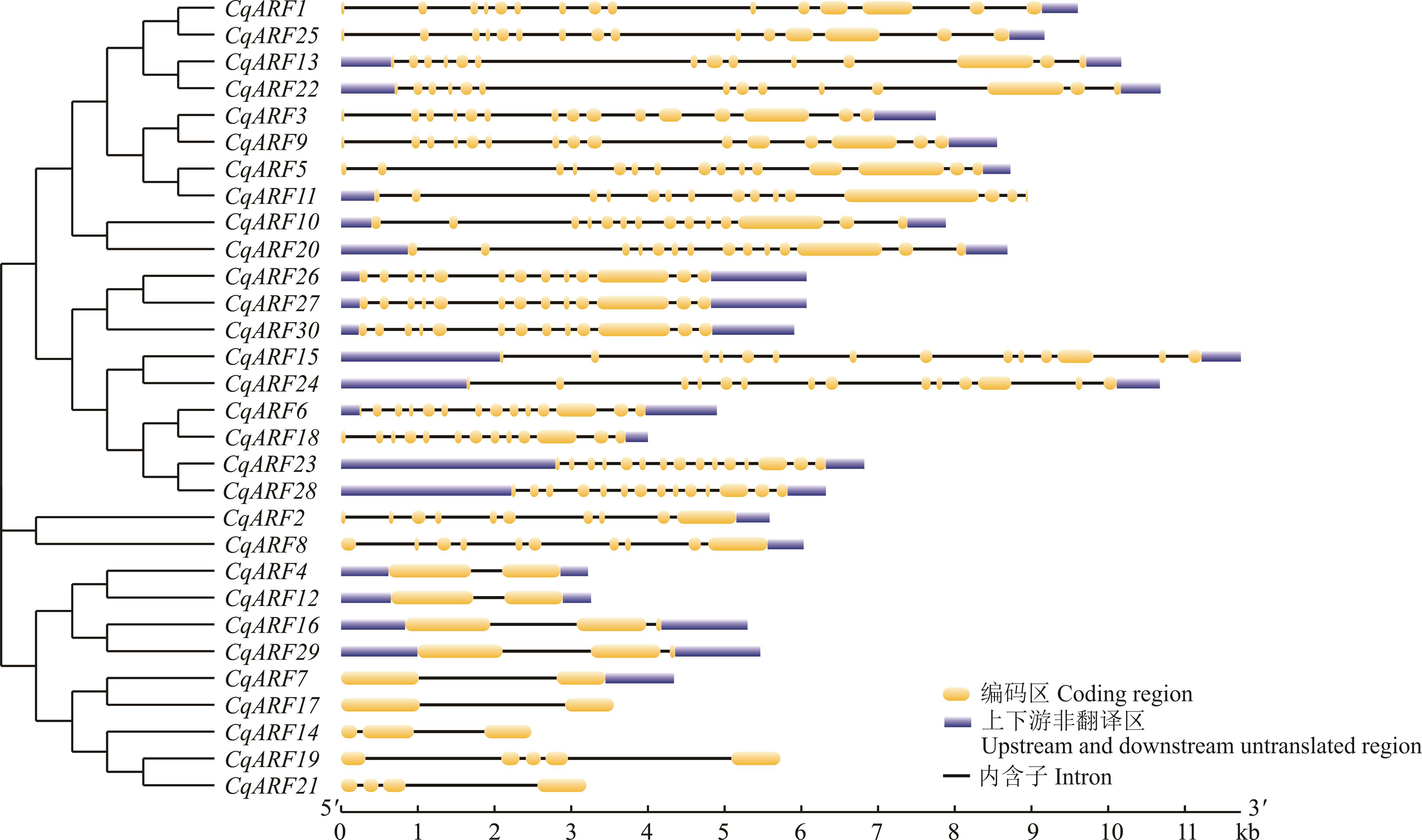
图1 藜麦ARF基因结构分析
Fig.1 Gene structure analysis of ARF in C. quinoa

图2 藜麦ARF的染色体定位Chr: 染色体 Chromosome.
Fig.2 Chromosomal mapping of ARF in C. quinoa
蛋白 Protein | 百分比 Percentage (%) | 亚细胞定位 Subcellular localization | 蛋白 Protein | 百分比 Percentage (%) | 亚细胞定位 Subcellular localization | ||||||
|---|---|---|---|---|---|---|---|---|---|---|---|
α-螺旋 α-helix | 延伸链 ES | β-转角 β-turn | 无规则卷曲 Random coil | α-螺旋 α-helix | 延伸链 ES | β-转角 β-turn | 无规则卷曲 Random coil | ||||
| CqARF1 | 23.39 | 15.20 | 3.86 | 57.54 | N | CqARF16 | 17.84 | 16.12 | 4.75 | 61.29 | N |
| CqARF2 | 16.67 | 14.29 | 4.76 | 64.29 | N | CqARF17 | 14.10 | 17.54 | 3.80 | 64.56 | C |
| CqARF3 | 25.00 | 13.70 | 5.44 | 55.86 | N | CqARF18 | 18.50 | 16.59 | 4.15 | 60.77 | N |
| CqARF4 | 19.61 | 16.99 | 4.41 | 58.99 | N | CqARF19 | 22.28 | 18.00 | 3.74 | 55.97 | C |
| CqARF5 | 28.54 | 15.94 | 6.30 | 49.21 | N | CqARF20 | 25.20 | 15.66 | 3.75 | 55.39 | N |
| CqARF6 | 19.48 | 17.81 | 4.72 | 57.99 | N | CqARF21 | 14.16 | 19.55 | 3.82 | 62.47 | N |
| CqARF7 | 13.30 | 17.67 | 4.37 | 64.66 | C | CqARF22 | 27.46 | 14.53 | 3.20 | 54.80 | N |
| CqARF8 | 15.96 | 14.53 | 4.42 | 65.09 | N | CqARF23 | 19.29 | 17.52 | 4.82 | 58.36 | N |
| CqARF9 | 25.05 | 14.06 | 5.50 | 55.39 | N | CqARF24 | 18.96 | 17.50 | 4.05 | 59.48 | N |
| CqARF10 | 27.52 | 14.50 | 3.74 | 54.25 | N | CqARF25 | 23.29 | 15.18 | 3.31 | 58.22 | N |
| CqARF11 | 33.88 | 14.65 | 7.88 | 43.59 | N | CqARF26 | 19.93 | 14.86 | 3.50 | 61.71 | N |
| CqARF12 | 20.10 | 15.85 | 5.07 | 58.99 | N | CqARF27 | 20.29 | 15.22 | 3.50 | 60.99 | N |
| CqARF13 | 26.90 | 14.72 | 3.38 | 55.01 | N | CqARF28 | 20.68 | 17.12 | 4.68 | 57.51 | N |
| CqARF14 | 12.70 | 19.88 | 4.10 | 63.32 | N | CqARF29 | 18.42 | 14.68 | 4.46 | 62.45 | N |
| CqARF15 | 19.19 | 17.26 | 4.35 | 59.19 | N | CqARF30 | 19.73 | 14.65 | 3.87 | 61.74 | N |
表3 藜麦ARF的二级结构分析和亚细胞定位预测
Table 3 Secondary structure analysis and subcellular localization prediction of ARF in C. quinoa
蛋白 Protein | 百分比 Percentage (%) | 亚细胞定位 Subcellular localization | 蛋白 Protein | 百分比 Percentage (%) | 亚细胞定位 Subcellular localization | ||||||
|---|---|---|---|---|---|---|---|---|---|---|---|
α-螺旋 α-helix | 延伸链 ES | β-转角 β-turn | 无规则卷曲 Random coil | α-螺旋 α-helix | 延伸链 ES | β-转角 β-turn | 无规则卷曲 Random coil | ||||
| CqARF1 | 23.39 | 15.20 | 3.86 | 57.54 | N | CqARF16 | 17.84 | 16.12 | 4.75 | 61.29 | N |
| CqARF2 | 16.67 | 14.29 | 4.76 | 64.29 | N | CqARF17 | 14.10 | 17.54 | 3.80 | 64.56 | C |
| CqARF3 | 25.00 | 13.70 | 5.44 | 55.86 | N | CqARF18 | 18.50 | 16.59 | 4.15 | 60.77 | N |
| CqARF4 | 19.61 | 16.99 | 4.41 | 58.99 | N | CqARF19 | 22.28 | 18.00 | 3.74 | 55.97 | C |
| CqARF5 | 28.54 | 15.94 | 6.30 | 49.21 | N | CqARF20 | 25.20 | 15.66 | 3.75 | 55.39 | N |
| CqARF6 | 19.48 | 17.81 | 4.72 | 57.99 | N | CqARF21 | 14.16 | 19.55 | 3.82 | 62.47 | N |
| CqARF7 | 13.30 | 17.67 | 4.37 | 64.66 | C | CqARF22 | 27.46 | 14.53 | 3.20 | 54.80 | N |
| CqARF8 | 15.96 | 14.53 | 4.42 | 65.09 | N | CqARF23 | 19.29 | 17.52 | 4.82 | 58.36 | N |
| CqARF9 | 25.05 | 14.06 | 5.50 | 55.39 | N | CqARF24 | 18.96 | 17.50 | 4.05 | 59.48 | N |
| CqARF10 | 27.52 | 14.50 | 3.74 | 54.25 | N | CqARF25 | 23.29 | 15.18 | 3.31 | 58.22 | N |
| CqARF11 | 33.88 | 14.65 | 7.88 | 43.59 | N | CqARF26 | 19.93 | 14.86 | 3.50 | 61.71 | N |
| CqARF12 | 20.10 | 15.85 | 5.07 | 58.99 | N | CqARF27 | 20.29 | 15.22 | 3.50 | 60.99 | N |
| CqARF13 | 26.90 | 14.72 | 3.38 | 55.01 | N | CqARF28 | 20.68 | 17.12 | 4.68 | 57.51 | N |
| CqARF14 | 12.70 | 19.88 | 4.10 | 63.32 | N | CqARF29 | 18.42 | 14.68 | 4.46 | 62.45 | N |
| CqARF15 | 19.19 | 17.26 | 4.35 | 59.19 | N | CqARF30 | 19.73 | 14.65 | 3.87 | 61.74 | N |
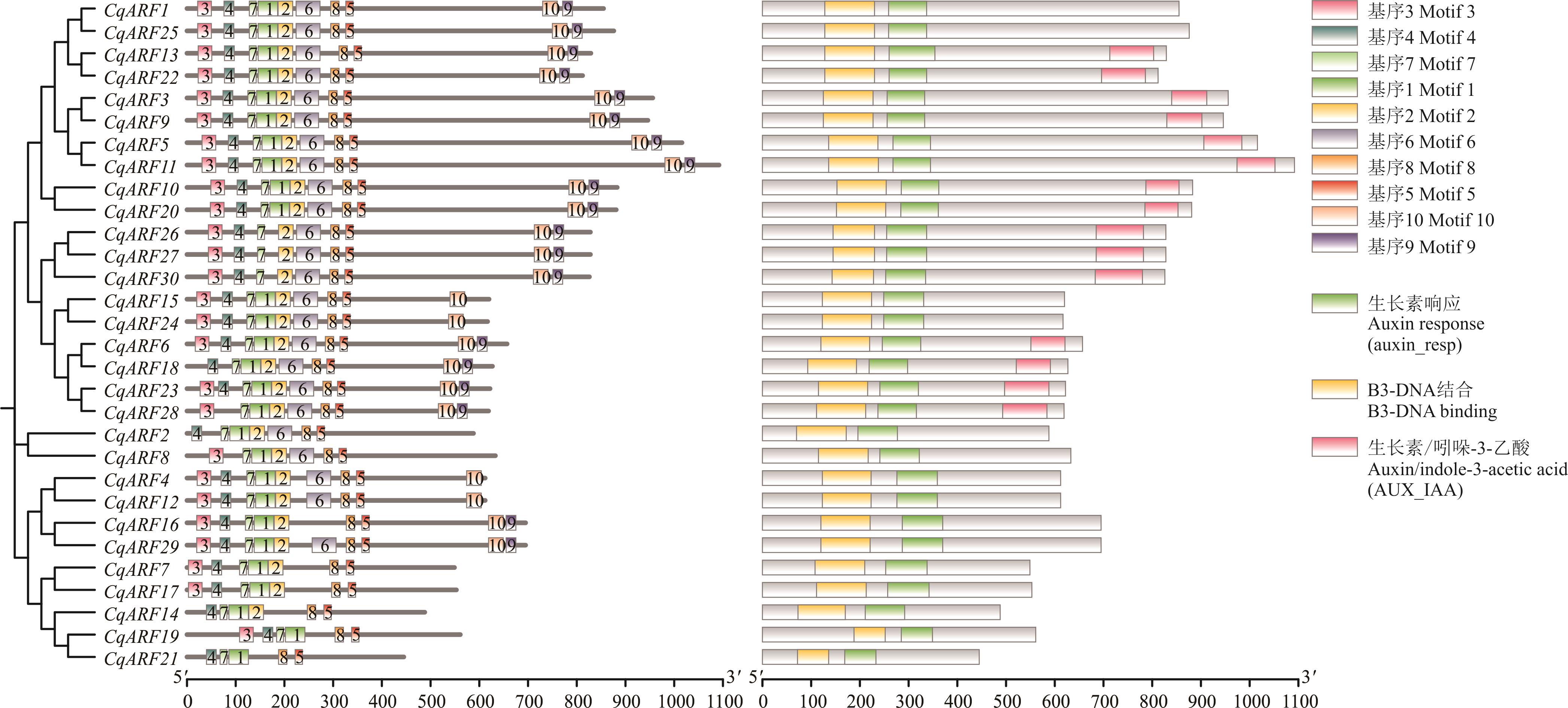
图3 藜麦ARF蛋白的保守基序和结构域分析
Fig.3 Motif and domain analysis of ARF proteins in C. quinoa

图4 藜麦ARFs的启动子顺式作用元件分析
Fig.4 Analysis of the promoter cis-acting element of ARFs in C. quinoa
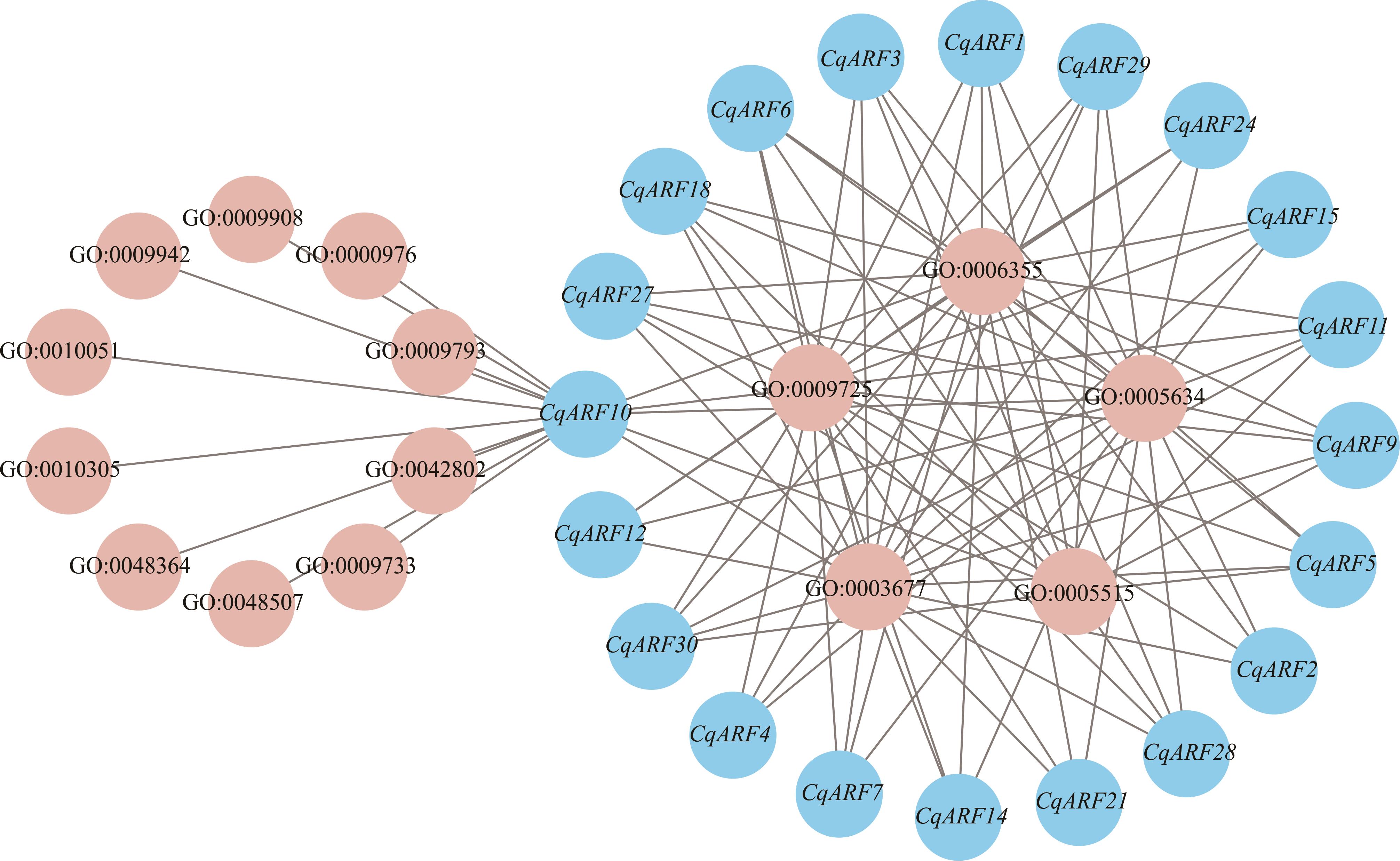
图5 藜麦ARFs的GO富集分析GO:0003677, DNA结合 DNA binding; GO:0005515, 蛋白结合Protein binding; GO:0005634, 细胞核Nucleus; GO:0006355, DNA转录调控Regulation of DNA-templated transcription; GO:0009725, 对激素反应Response to hormone; GO:0009733, 对生长素反应Response to auxin; GO:0009793, 胚胎发育结束于种子休眠Embryo development ending in seed dormancy; GO:0000976, 转录顺式调节区结合Transcription cis-regulatory region binding; GO:0009908, 花卉发育Flower development; GO:0009942, 纵轴规格Longitudinal axis specification; GO:0010051, 木质部和韧皮部模式的形成Xylem and phloem pattern formation; GO:0010305, 叶片维管组织模式形成Leaf vascular tissue pattern formation; GO:0042802, 相同的蛋白质结合Identical protein binding; GO:0048364, 根系发育Root development; GO:0048507, 分生组织发育Meristem development.
Fig.5 GO enrichment analysis of ARFs in C. quinoa

图6 拟南芥、甜菜、菠菜、藜麦、大豆、水稻、高粱、小麦和玉米ARF家族的系统进化树At: 拟南芥 A. thaliana; KM: 甜菜 B. vulgaris; SOV: 菠菜 S. oleracea; Cq:藜麦 C. quinoa; KRG、KRH、RCW: 大豆 G. max; Os: 水稻 O. sativa; TraesCS: 小麦 T. aestivum; Zm: 玉米 Z. mays; EES、EER、OQU、KXG: 高粱S. bicolor; 下同The same below.
Fig.6 Phylogenetic tree of the ARF family of A. thaliana, sugar beet, spinach, quinoa, soybean, rice, sorghum, wheat and maize

图7 拟南芥、甜菜、菠菜和藜麦ARF家族的系统进化树
Fig.7 Phylogenetic tree of the ARF family of A. thaliana, sugar beet, spinach, and quinoa

图8 藜麦ARFs与菠菜、甜菜的共线性分析So: 菠菜 S. oleracea; Cq: 藜麦 C. quinoa; Bv: 甜菜 B. vulgaris; -1, -2, …, -N: 第1, 2, …, N号染色体 Chromosomes 1, 2, ..., N.
Fig.8 Collineearity analysis of ARFs in C.quinoa with S.oleracea and B. vulgaris
基因 1 Gene 1 | 基因 2 Gene 2 | 非同义突变率 Nonsynonymous mutation rate (Ka) | 同义突变率 Synonymous mutation rate (Ks) | Ka/Ks | 复制方式 Reproduction method |
|---|---|---|---|---|---|
| CqARF6 | CqARF23 | 0.303711934 | 1.799526020 | 0.168773294 | 片段重复Segmental |
| CqARF6 | CqARF28 | 0.315466921 | 2.426265491 | 0.130021600 | 片段重复Segmental |
| CqARF6 | CqARF18 | 0.026772832 | 0.087442224 | 0.306177390 | 片段重复Segmental |
| CqARF7 | CqARF17 | 0.044005625 | 0.114549220 | 0.384163460 | 片段重复Segmental |
| CqARF13 | CqARF22 | 0.003744324 | 0.065036080 | 0.057573034 | 片段重复Segmental |
| CqARF23 | CqARF28 | 0.021890044 | 0.124503376 | 0.175818881 | 片段重复Segmental |
| CqARF2 | CqARF8 | 0.015303726 | 0.096195701 | 0.159089495 | 片段重复Segmental |
| CqARF1 | CqARF25 | 0.006629596 | 0.050358851 | 0.131647080 | 片段重复Segmental |
| CqARF18 | CqARF28 | 0.319129591 | 2.155157368 | 0.148077164 | 片段重复Segmental |
| CqARF18 | CqARF23 | 0.316229623 | 1.753180105 | 0.180374864 | 片段重复Segmental |
| CqARF3 | CqARF9 | 0.009643482 | 0.095576199 | 0.100898363 | 片段重复Segmental |
| CqARF5 | CqARF11 | 0.013328907 | 0.079634402 | 0.167376241 | 片段重复Segmental |
| CqARF26 | CqARF30 | 0.012628000 | 0.067031715 | 0.188388442 | 片段重复Segmental |
| CqARF10 | CqARF20 | 0.014057937 | 0.080890289 | 0.173790171 | 片段重复Segmental |
| CqARF4 | CqARF12 | 0.010622153 | 0.078919709 | 0.134594430 | 片段重复Segmental |
| CqARF27 | CqARF30 | 0.011572071 | 0.070838085 | 0.163359461 | 片段重复Segmental |
表4 藜麦ARFs的进化选择参数分析
Table 4 Analysis of evolutionary selection parameters of ARFs in C.quinoa
基因 1 Gene 1 | 基因 2 Gene 2 | 非同义突变率 Nonsynonymous mutation rate (Ka) | 同义突变率 Synonymous mutation rate (Ks) | Ka/Ks | 复制方式 Reproduction method |
|---|---|---|---|---|---|
| CqARF6 | CqARF23 | 0.303711934 | 1.799526020 | 0.168773294 | 片段重复Segmental |
| CqARF6 | CqARF28 | 0.315466921 | 2.426265491 | 0.130021600 | 片段重复Segmental |
| CqARF6 | CqARF18 | 0.026772832 | 0.087442224 | 0.306177390 | 片段重复Segmental |
| CqARF7 | CqARF17 | 0.044005625 | 0.114549220 | 0.384163460 | 片段重复Segmental |
| CqARF13 | CqARF22 | 0.003744324 | 0.065036080 | 0.057573034 | 片段重复Segmental |
| CqARF23 | CqARF28 | 0.021890044 | 0.124503376 | 0.175818881 | 片段重复Segmental |
| CqARF2 | CqARF8 | 0.015303726 | 0.096195701 | 0.159089495 | 片段重复Segmental |
| CqARF1 | CqARF25 | 0.006629596 | 0.050358851 | 0.131647080 | 片段重复Segmental |
| CqARF18 | CqARF28 | 0.319129591 | 2.155157368 | 0.148077164 | 片段重复Segmental |
| CqARF18 | CqARF23 | 0.316229623 | 1.753180105 | 0.180374864 | 片段重复Segmental |
| CqARF3 | CqARF9 | 0.009643482 | 0.095576199 | 0.100898363 | 片段重复Segmental |
| CqARF5 | CqARF11 | 0.013328907 | 0.079634402 | 0.167376241 | 片段重复Segmental |
| CqARF26 | CqARF30 | 0.012628000 | 0.067031715 | 0.188388442 | 片段重复Segmental |
| CqARF10 | CqARF20 | 0.014057937 | 0.080890289 | 0.173790171 | 片段重复Segmental |
| CqARF4 | CqARF12 | 0.010622153 | 0.078919709 | 0.134594430 | 片段重复Segmental |
| CqARF27 | CqARF30 | 0.011572071 | 0.070838085 | 0.163359461 | 片段重复Segmental |
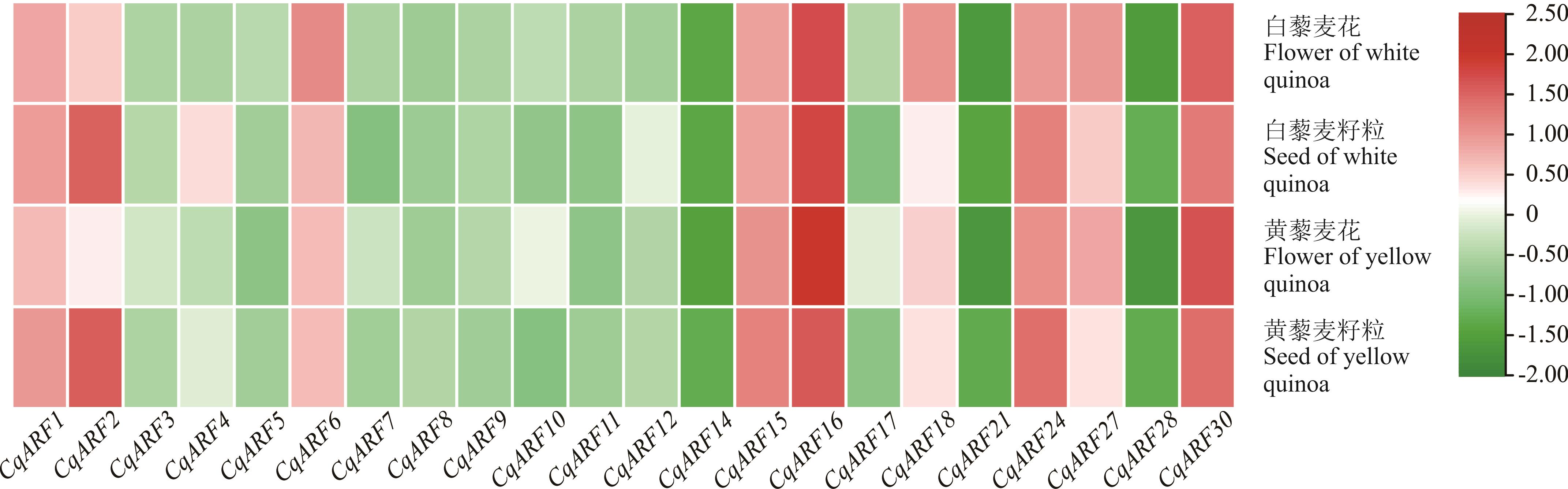
图9 ARF基因在藜麦花、籽粒中的表达分析
Fig.9 Expression analysis of ARF genes in C.quinoa including flower and seed
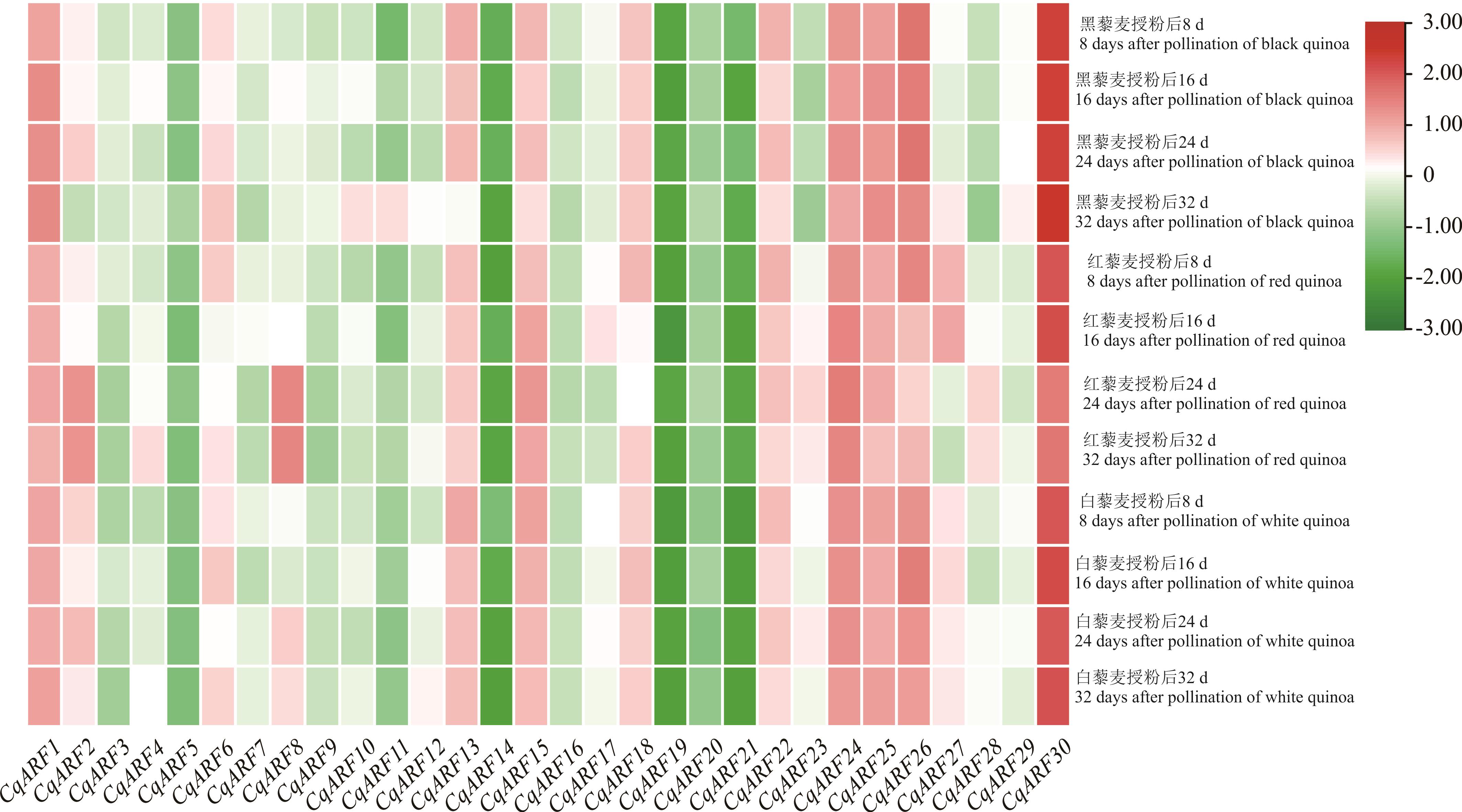
图10 藜麦籽粒发育时期CqARF基因的表达
Fig.10 Expression of CqARF genes during grain development in C. quinoa

图11 藜麦籽粒发育时期部分CqARF基因的表达A: 黑藜麦Black quinoa; B: 红藜麦Red quinoa; C: 白藜麦White quinoa; 不同字母表示同基因不同时间差异显著(P<0.05) Different letters indicate significant differences among different time after pollination of the same gene (P<0.05).
Fig.11 Expression of some CqARF genes during grain development in C. quinoa
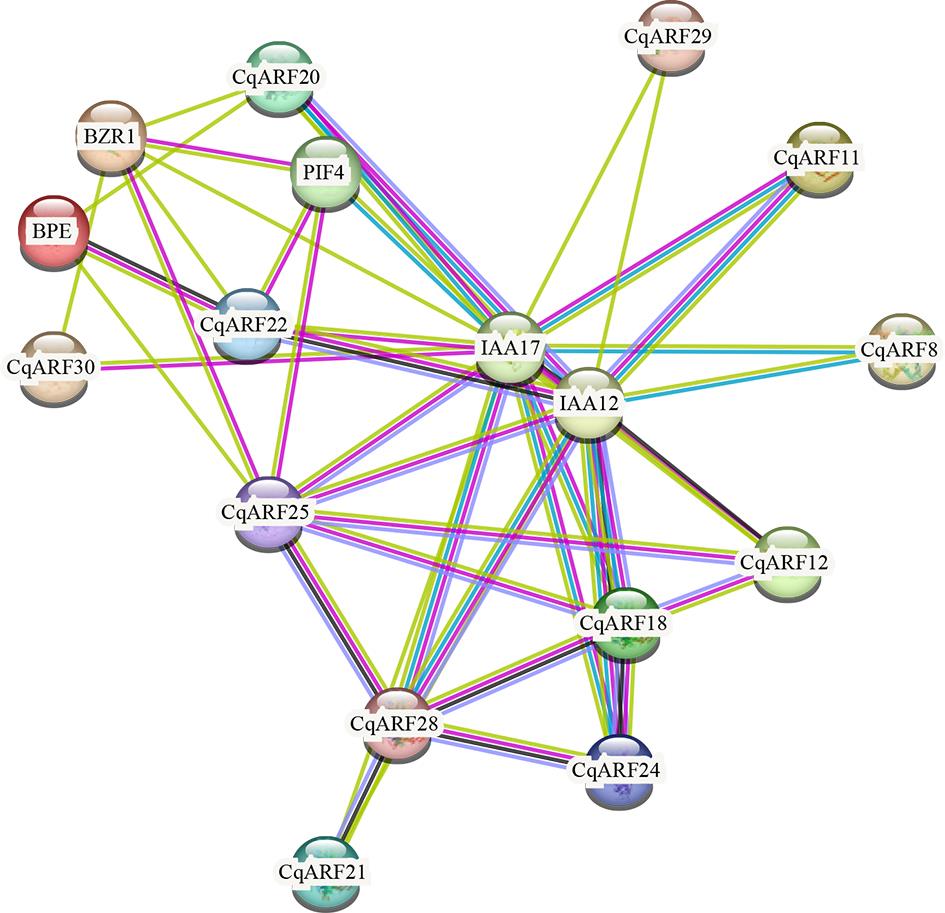
图12 藜麦ARF的蛋白互作网络分析BPEp: 大花瓣P Big petal P; BZR1: 抗油菜素固醇1 Brassinazole-resistant 1; PIF4: 植物色素相互作用因子4 Phytochrome-interacting factor 4; IAA: 生长素/吲哚-3-乙酸蛋白Auxin/indole-3-acetic acid protein.
Fig.12 Protein-protein interaction network analysis of ARF in C.quinoa
基因ID Gene ID | 变异位点 Position of variation (POS) | 参考碱基 Reference allele (REF) | 突变碱基 Alternative allele (ALT) | 质量值 Quality | CQ3 | CQ6 | CQ8 | CQ9 | 单核苷酸多态性效应 Single nucleotide polymorphism_effect |
|---|---|---|---|---|---|---|---|---|---|
| CqARF1 | 137066642 | A | C | 80.20 | A,A | A,A | N | A,C | 上游效应Upstream |
| CqARF1 | 137068065 | A | G | 48.60 | A,A | A,G | N | N | 上游效应Upstream |
| CqARF1 | 137067017 | A | G | 323.12 | A,A | A,G | A,G | A,G | 上游效应Upstream |
| CqARF1 | 137070583 | A | G | 408.19 | A,A | A,G | A,G | G,G | 内含子Intron |
| CqARF1 | 137070760 | T | C | 372.22 | T,T | T,C | T,C | C,C | 内含子Intron |
| CqARF1 | 137074788 | T | C | 158.20 | N | T,T | T,T | T,C | 内含子Intron |
| CqARF1 | 137069513 | C | T | 1109.46 | T,T | T,T | T,T | T,T | 内含子Intron |
| CqARF24 | 40101003 | A | G | 119.14 | G,G | A,A | A,A | A,A | 上游效应Upstream |
| CqARF24 | 40101130 | G | A | 172.59 | A,A | G,G | G,G | G,G | 上游效应 Upstream |
| CqARF24 | 40103100 | T | A | 172.26 | A,A | T,T | N | T,T | 上游效应Upstream |
| CqARF24 | 40102779 | C | T | 79.74 | C,T | C,C | C,C | C,C | 上游效应Upstream |
| CqARF24 | 40103316 | T | A | 79.84 | T,T | T,T | T,T | A,A | 上游效应Upstream |
| CqARF24 | 40103661 | A | G | 49.35 | G,G | A,A | A,A | A,A | 上游效应Upstream |
| CqARF24 | 40102722 | C | T | 178.98 | T,T | C,C | C,C | C,C | 上游效应Upstream |
| CqARF24 | 40103742 | T | C | 51.02 | N | T,T | C,C | T,T | 上游效应Upstream |
| CqARF24 | 40116631 | G | A | 89.39 | A,A | G,G | G,G | G,G | 下游效应Downstream |
| CqARF24 | 40119474 | T | C | 53.44 | C,C | T,T | T,T | N | 下游效应Downstream |
表5 4个藜麦品种CqARFs的单核苷酸多态性DNA变异分析
Table 5 Analysis of single nucleotide polymorphism (SNP) DNA variation of CqARFs in four quinoa cultivars
基因ID Gene ID | 变异位点 Position of variation (POS) | 参考碱基 Reference allele (REF) | 突变碱基 Alternative allele (ALT) | 质量值 Quality | CQ3 | CQ6 | CQ8 | CQ9 | 单核苷酸多态性效应 Single nucleotide polymorphism_effect |
|---|---|---|---|---|---|---|---|---|---|
| CqARF1 | 137066642 | A | C | 80.20 | A,A | A,A | N | A,C | 上游效应Upstream |
| CqARF1 | 137068065 | A | G | 48.60 | A,A | A,G | N | N | 上游效应Upstream |
| CqARF1 | 137067017 | A | G | 323.12 | A,A | A,G | A,G | A,G | 上游效应Upstream |
| CqARF1 | 137070583 | A | G | 408.19 | A,A | A,G | A,G | G,G | 内含子Intron |
| CqARF1 | 137070760 | T | C | 372.22 | T,T | T,C | T,C | C,C | 内含子Intron |
| CqARF1 | 137074788 | T | C | 158.20 | N | T,T | T,T | T,C | 内含子Intron |
| CqARF1 | 137069513 | C | T | 1109.46 | T,T | T,T | T,T | T,T | 内含子Intron |
| CqARF24 | 40101003 | A | G | 119.14 | G,G | A,A | A,A | A,A | 上游效应Upstream |
| CqARF24 | 40101130 | G | A | 172.59 | A,A | G,G | G,G | G,G | 上游效应 Upstream |
| CqARF24 | 40103100 | T | A | 172.26 | A,A | T,T | N | T,T | 上游效应Upstream |
| CqARF24 | 40102779 | C | T | 79.74 | C,T | C,C | C,C | C,C | 上游效应Upstream |
| CqARF24 | 40103316 | T | A | 79.84 | T,T | T,T | T,T | A,A | 上游效应Upstream |
| CqARF24 | 40103661 | A | G | 49.35 | G,G | A,A | A,A | A,A | 上游效应Upstream |
| CqARF24 | 40102722 | C | T | 178.98 | T,T | C,C | C,C | C,C | 上游效应Upstream |
| CqARF24 | 40103742 | T | C | 51.02 | N | T,T | C,C | T,T | 上游效应Upstream |
| CqARF24 | 40116631 | G | A | 89.39 | A,A | G,G | G,G | G,G | 下游效应Downstream |
| CqARF24 | 40119474 | T | C | 53.44 | C,C | T,T | T,T | N | 下游效应Downstream |
| [1] | Casanova-Sáez R, Mateo-Bonmatí E, Ljung K. Auxin metabolism in plants. Cold Spring Harbor Perspectives in Biology, 2021, 13(3): a039867. |
| [2] | Abel S, Theologis A. Early genes and auxin action. Plant Physiology, 1996, 111(1): 9-17. |
| [3] | Ulmasov T, Hagen G, Guilfoyle T J. Dimerization and DNA binding of auxin response factors. The Plant Journal, 1999, 19(3): 309-319. |
| [4] | Okushima Y, Overvoorde P J, Arima K, et al. Functional genomic analysis of the AUXIN RESPONSE FACTOR gene family members in Arabidopsis thaliana: Unique and overlapping functions of ARF7 and ARF19. The Plant Cell, 2005, 17(2): 444-463. |
| [5] | Wang D K, Pei K M, Fu Y P, et al. Genome-wide analysis of the auxin response factors (ARF) gene family in rice (Oryza sativa). Gene, 2007, 394(1/2): 13-24. |
| [6] | Chen D, Wang W A, Wu Y Q, et al. Expression and distribution of the auxin response factors in Sorghum bicolor during development and temperature stress. International Journal of Molecular Sciences, 2019, 20(19): 4816. |
| [7] | Xu L, Wang D, Liu S, et al. Comprehensive atlas of wheat (Triticum aestivum L.) AUXIN RESPONSE FACTOR expression during male reproductive development and abiotic stress. Frontiers in Plant Science, 2020, 11: 586144. |
| [8] | Wang Y, Deng D, Shi Y, et al. Diversification, phylogeny and evolution of auxin response factor (ARF) family: Insights gained from analyzing maize ARF genes. Molecular Biology Reports, 2012, 39(3): 2401-2415. |
| [9] | Zhao Y, Weng Q Y, Ma H L, et al. Genome-wide identification and bioinformatics analysis of ARF gene family in Setaria italic. Journal of Plant Genetic Resources, 2016, 17(3): 547-554. |
| 赵艳, 瓮巧云, 马海莲, 等. 谷子ARF基因家族的鉴定与生物信息学分析. 植物遗传资源学报, 2016, 17(3): 547-554. | |
| [10] | Tang Y, Du G, Xiang J, et al. Genome-wide identification of auxin response factor (ARF) gene family and the miR160-ARF18-mediated response to salt stress in peanut (Arachis hypogaea L.). Genomics, 2022, 114(1): 171-184. |
| [11] | Tiwari S B, Hagen G, Guilfoyle T. The roles of auxin response factor domains in auxin-responsive transcription. The Plant Cell, 2003, 15(2): 533-543. |
| [12] | Rienstra J, Hernández-García J, Weijers D. To bind or not to bind: How AUXIN RESPONSE FACTORs select their target genes. Journal of Experimental Botany, 2023, 74(22): 6922-6932. |
| [13] | Chaudhary C, Sharma N, Khurana P. Genome-wide identification of Aux/IAA and ARF gene families in bread wheat (Triticum aestivum L.). Protoplasma, 2023, 260(1): 257-270. |
| [14] | Sima X J, Zheng B S. Advances in primary auxin-responsive Aux/IAA gene family: A review. Journal of Zhejiang A&F University, 2015, 32(2): 313-318. |
| 司马晓娇, 郑炳松. 植物生长素原初响应基因Aux/IAA研究进展. 浙江农林大学学报, 2015, 32(2): 313-318. | |
| [15] | Zhao Z, Andersen S U, Ljung K, et al. Hormonal control of the shoot stem-cell niche. Nature, 2010, 465(7301): 1089-1092. |
| [16] | Hardtke C S, Berleth T. The Arabidopsis gene MONOPTEROS encodes a transcription factor mediating embryo axis formation and vascular development. The EMBO Journal, 1998, 17(5): 1405-1411. |
| [17] | Harper R M, Stowe-Evans E L, Luesse D R, et al. The NPH4 locus encodes the auxin response factor ARF7, a conditional regulator of differential growth in aerial Arabidopsis tissue. The Plant Cell, 2000, 12(5): 757-770. |
| [18] | Nagpal P, Ellis C M, Weber H, et al. Auxin response factors ARF6 and ARF8 promote jasmonic acid production and flower maturation. Development, 2005, 132(18): 4107-4118. |
| [19] | Okushima Y, Fukaki H, Onoda M, et al. ARF7 and ARF19 regulate lateral root formation via direct activation of LBD/ASL genes in Arabidopsis. The Plant Cell, 2007, 19(1): 118-130. |
| [20] | Wilmoth J C, Wang S, Tiwari S B, et al. NPH4/ARF7 and ARF19 promote leaf expansion and auxin-induced lateral root formation. The Plant Journal, 2005, 43(1): 118-130. |
| [21] | Waller F, Furuya M, Nick P. OsARF1, an auxin response factor from rice, is auxin-regulated and classifies as a primary auxin responsive gene. Plant Molecular Biology, 2002, 50(3): 415-425. |
| [22] | Attia K A, Abdelkhalik A F, Ammar M H, et al. Antisense phenotypes reveal a functional expression of OsARF1, an auxin response factor, in transgenic rice. Current Issues in Molecular Biology, 2009, 11(1): 29-34. |
| [23] | Li X P, Zeng Q F, Zhang G S, et al. The regulation effect of the soybean auxin response factor gene GmARF17 on the growth and development of hypocotyls. Journal of Nuclear Agricultural Sciences, 2015, 29(9): 1668-1676. |
| 李小平, 曾庆发, 张根生, 等. 大豆生长素响应因子基因GmARF17对胚轴生长发育的调控作用. 核农学报, 2015, 29(9): 1668-1676. | |
| [24] | Sun W, Yu H, Ma Z, et al. Molecular evolution and local root heterogeneous expression of the Chenopodium quinoa ARF genes provide insights into the adaptive domestication of crops in complex environments. Journal of Molecular Evolution, 2021, 89(4/5): 287-301. |
| [25] | Wang B, Zhu X, Song X, et al. Identification of ARF gene family and functional analysis of CqARF05 under drought and salt stress in quinoa. Scientific Reports, 2025, 15(1): 5072. |
| [26] | Jarvis D E, Ho Y S, Lightfoot D J, et al. The genome of Chenopodium quinoa. Nature, 2017, 542(7641): 307-312. |
| [27] | Hu B, Jin J, Guo A Y, et al. GSDS 2.0: An upgraded gene feature visualization server. Bioinformatics, 2015, 31(8): 1296-1297. |
| [28] | Fan J L, Zhu L X, Guo Z Q, et al. Identification of JAZ gene family and analysis on their differential expression under freezing stress and DNA variation in common wheat. Plant Physiology Journal, 2022, 58(10): 1873-1889. |
| 范佳利, 朱立勋, 郭志强, 等. 普通小麦JAZ基因家族鉴定及其响应冻害时基因差异表达和DNA变异分析. 植物生理学报, 2022, 58(10): 1873-1889. | |
| [29] | Korasick D A, Jez J M, Strader L C. Refining the nuclear auxin response pathway through structural biology. Current Opinion in Plant Biology, 2015, 27: 22-28. |
| [30] | Liu Z, Miao L, Huo R, et al. ARF2-ARF4 and ARF5 are essential for female and male gametophyte development in Arabidopsis. Plant & Cell Physiology, 2018, 59(1): 179-189. |
| [31] | Pan G, Yang X, He J, et al. Comprehensive analyses of the ARF gene family in cannabis reveals their potential roles in regulating cannabidiol biosynthesis and male flower development. Frontiers in Plant Science, 2024, 15: 1394337. |
| [32] | Zhang M J, Xue Y Y, Xu S, et al. Identification of ARF genes in Cucurbita pepo L. and analysis of expression patterns, and functional analysis of CpARF22 under drought, salt stress. BMC Genomics, 2024, 25(1): 112. |
| [33] | Gao Z, Wu Y, Li M, et al. The auxin response factor (ARF) gene family in Cyclocarya paliurus: Genome-wide identification and their expression profiling under heat and drought stresses. Physiology and Molecular Biology of Plants, 2024, 30(6): 921-944. |
| [34] | Xu H S, Jiang X D, Wang X L, et al. Identification and characterisation of auxin-binding protein gene ABP1 in Chenopodium quinoa. Plant Physiology Journal, 2024, 60(7): 1157-1167. |
| 徐宏申, 姜晓东, 王锡亮, 等. 藜麦生长素结合蛋白基因ABP1的鉴定与表达分析. 植物生理学报, 2024, 60(7): 1157-1167. |
| [1] | 赵颖, 张聪聪, 宋雨婷, 张翀敏, 安悦, 杨宾宾, 马永, 王宝强. 2,4-表油菜素内酯对盐碱胁迫下藜麦幼苗生长的促进效应[J]. 草业学报, 2026, 35(9): 100-112. |
| [2] | 刘进娣, 陈仕勇, 李进, 蒋涛, 梁国玲, 周青平. 燕麦蔗糖转运蛋白基因家族的鉴定及其对干旱和盐碱胁迫的响应[J]. 草业学报, 2026, 35(8): 144-156. |
| [3] | 李凤, 郭绪虎, 曹慧芬, 孔祥睿, 杨冬雪, 张东旭, 张永芳. 藜麦NAC转录因子CqNAC66响应干旱和盐胁迫的功能研究[J]. 草业学报, 2026, 35(8): 170-181. |
| [4] | 第乙林, 刘思甜, 刘欣影, 杜泳, 李州. γ-氨基丁酸对镉胁迫下匍匐翦股颖耐受性及镉吸收转运的影响[J]. 草业学报, 2026, 35(2): 208-220. |
| [5] | 甘芮, 杨国斌, 隋晓青, 齐静, 靳瑰丽, 王玉祥, 彭建. 生物炭对盐碱胁迫下无芒雀麦幼苗生理和基因表达的影响[J]. 草业学报, 2026, 35(10): 117-128. |
| [6] | 王艺华, 任慈, 张盼玉, 刘翠玲, 何亮亮, 李洁仪, 刘超, 陈曙. 柱花草SgNAC1基因的耐盐功能研究[J]. 草业学报, 2026, 35(10): 144-155. |
| [7] | 窦苗苗, 姜晓东, 孙慧琼, 徐宏申, 王锡亮, 杨博慧, 柴文婷, 赵珊珊, 张春来. 藜麦CqSGT1基因克隆、表达模式与DNA变异分析[J]. 草业学报, 2026, 35(1): 223-240. |
| [8] | 王昶, 闵庚梅, 张丽娟, 陆建英, 牛早霞, 魏玉明, 杨发荣. 藜麦霜霉病及其综合防控研究进展[J]. 草业学报, 2025, 34(9): 194-205. |
| [9] | 秦楠, 曹瑞鹏, 高婧涵, 彭玉飞, 田淼, 吕红, 任璐, 殷辉, 赵晓军. 藜麦种子可培养内生真菌鉴定及分析[J]. 草业学报, 2025, 34(11): 98-113. |
| [10] | 孟亚静, 伍国强, 魏明. 甜菜BvABF基因家族全基因组鉴定及其ABA处理下表达模式分析[J]. 草业学报, 2024, 33(9): 94-110. |
| [11] | 宋淑珍, 朱才业, 刘立山, 宫旭胤, 雒瑞瑞. 断尾对兰州大尾羊脂肪细胞结构和脂肪代谢相关基因表达的影响[J]. 草业学报, 2024, 33(7): 94-104. |
| [12] | 孔海明, 宋家兴, 杨静, 李倩, 杨培志, 曹玉曼. 紫花苜蓿CAMTA基因家族鉴定及其在非生物胁迫下的表达模式分析[J]. 草业学报, 2024, 33(5): 143-154. |
| [13] | 孟超楠, 赵玉洁, 陈佳欣, 张旖璐, 王彦佳, 冯丽荣, 孙玉刚, 郭长虹. 2株青贮玉米根际固氮菌的筛选鉴定及促生作用研究[J]. 草业学报, 2024, 33(3): 174-185. |
| [14] | 陈嘉慧, 刘文献. 重要牧草组学数据图形可视化展示工具的构建及应用[J]. 草业学报, 2024, 33(2): 57-67. |
| [15] | 管瑾, 郭一荻, 刘凌云, 尹淑霞, 滕珂. 结缕草叶肉细胞原生质体瞬时基因表达系统的构建[J]. 草业学报, 2023, 32(7): 61-71. |
| 阅读次数 | ||||||
|
全文 |
|
|||||
|
摘要 |
|
|||||
