

ISSN 1004-5759 CN 62-1105/S
草业学报 ›› 2026, Vol. 35 ›› Issue (5): 175-184.DOI: 10.11686/cyxb2025236
• 研究论文 • 上一篇
刘娜娜1,2( ), 刘艳梅1,2(), 杨航宇3(), 张媛琦1,2, 李堃1,2
收稿日期:2025-06-16
修回日期:2025-08-08
出版日期:2026-05-20
发布日期:2026-03-11
通讯作者:
刘艳梅,杨航宇
作者简介:yhy-780601@163.com基金资助:
Na-na LIU1,2(), Yan-mei LIU1,2(), Hang-yu YANG3(), Yuan-qi ZHANG1,2, Kun LI1,2
Received:2025-06-16
Revised:2025-08-08
Online:2026-05-20
Published:2026-03-11
Contact:
Yan-mei LIU,Hang-yu YANG
摘要:
草甘膦已成为全球使用量最大和使用范围最广的除草剂之一,但其过度使用会威胁生态环境,如何降解土壤中草甘膦农药残留已成为人类面临的重大难题之一。本试验以大豆、油菜、野豌豆、二月兰、葱和板蓝根6种植物为研究对象,测定其生长45和90 d后对两种浓度草甘膦(0.05和0.25 mg·kg-1)的降解效应,并用土壤微生物量碳氮和土壤酶活性表征其对土壤的修复效应。结果表明:生长45 d后,草甘膦浓度为0.05 mg·kg-1时,油菜、大豆和野豌豆对草甘膦的降解率分别为49.1%、48.4%和48.1%;草甘膦浓度为0.25 mg·kg-1时,降解率分别为66.9%、61.2%和62.2%,其他植物对草甘膦的降解率影响效果不理想;大豆和野豌豆可显著提高草甘膦残留土壤的微生物量碳氮含量(P<0.05),表明其可促进土壤微生物的繁衍;大豆和野豌豆可显著提高草甘膦残留土壤的β-葡萄糖苷酶、β-半乳糖苷酶、N-乙酰-氨基葡萄糖苷酶、N-乙酰-氨基半乳糖苷酶和土壤碱性磷酸酶活性。表明其可促进土壤碳、氮、磷元素的循环,其他植物对草甘膦残留土壤的微生物量碳氮和酶活性影响效果不显著。因此,果树行间种植大豆和野豌豆可通过促进微生物的繁衍,加速土壤营养元素的循环,进而降解土壤草甘膦农药的残留,达到改良土壤质量的效果。
刘娜娜, 刘艳梅, 杨航宇, 张媛琦, 李堃. 种植作物对土壤草甘膦农药的降解效应研究[J]. 草业学报, 2026, 35(5): 175-184.
Na-na LIU, Yan-mei LIU, Hang-yu YANG, Yuan-qi ZHANG, Kun LI. The degradation effects of soil glyphosate pesticide by plant crops[J]. Acta Prataculturae Sinica, 2026, 35(5): 175-184.
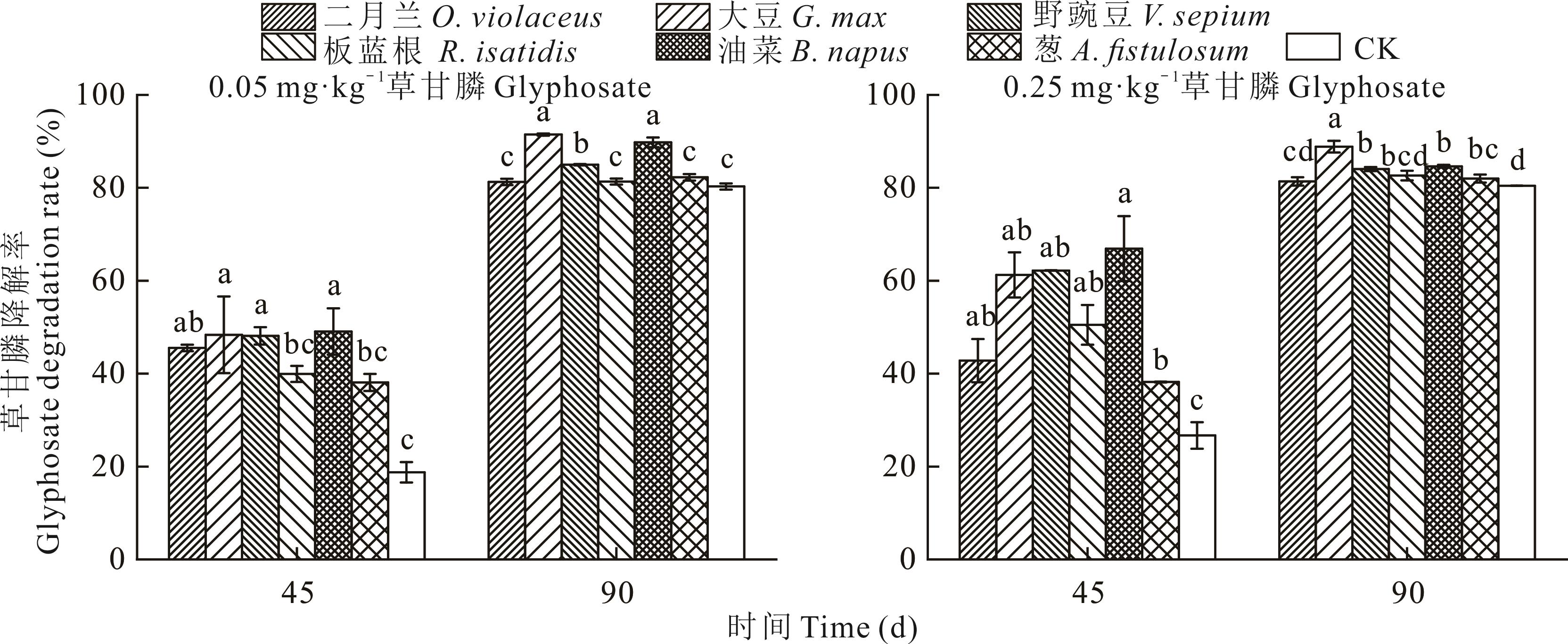
图1 种植作物对土壤草甘膦的降解效果不同小写字母表示同一时间不同种植作物间在P<0.05水平上差异显著,误差为标准误。Different lowercase letters indicate significant differences among different plant crops at the same time at the P<0.05 level, the error represents the standard error.
Fig.1 Degradation effects of plant crops on soil glyphosate
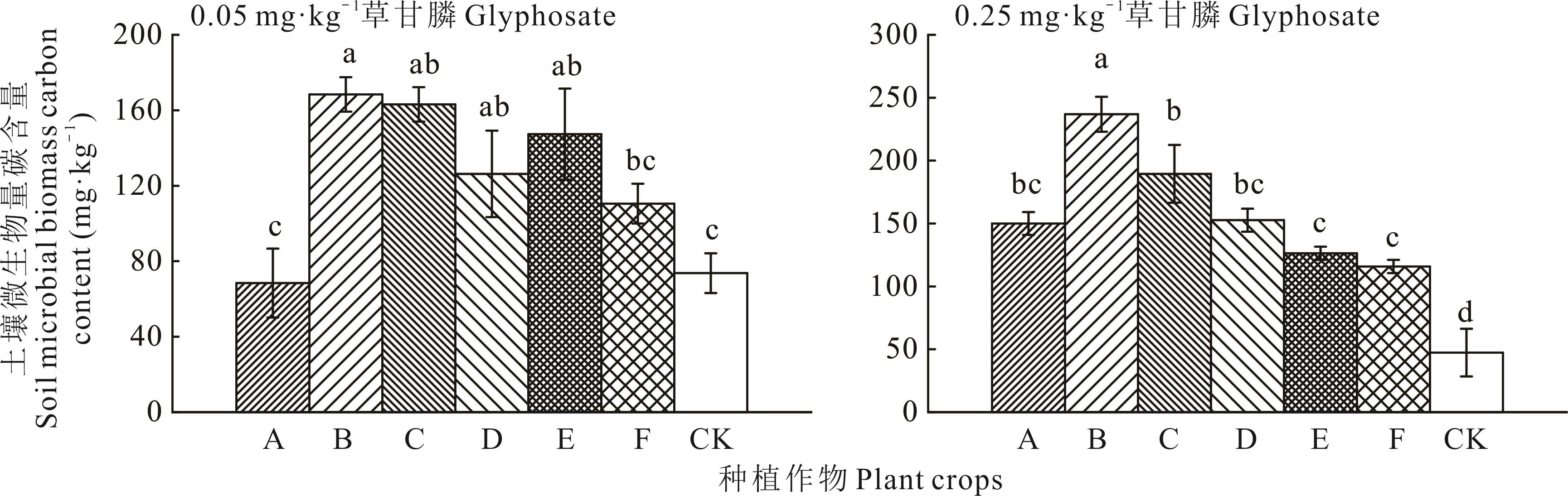
图2 种植作物对草甘膦残留土壤微生物量碳的影响A:二月兰 O. violaceus;B:大豆 G. max;C:野豌豆 V. sepium;D:板蓝根 R. isatidis;E:油菜 B. napus;F:葱 A. fistulosum. 下同The same below.不同小写字母表示在P<0.05水平上差异显著,下同。Different lowercase letters indicate significant differences at the P<0.05 level, the same below.
Fig.2 The effects of plant crops on microbial biomass carbon in glyphosate-residual soil
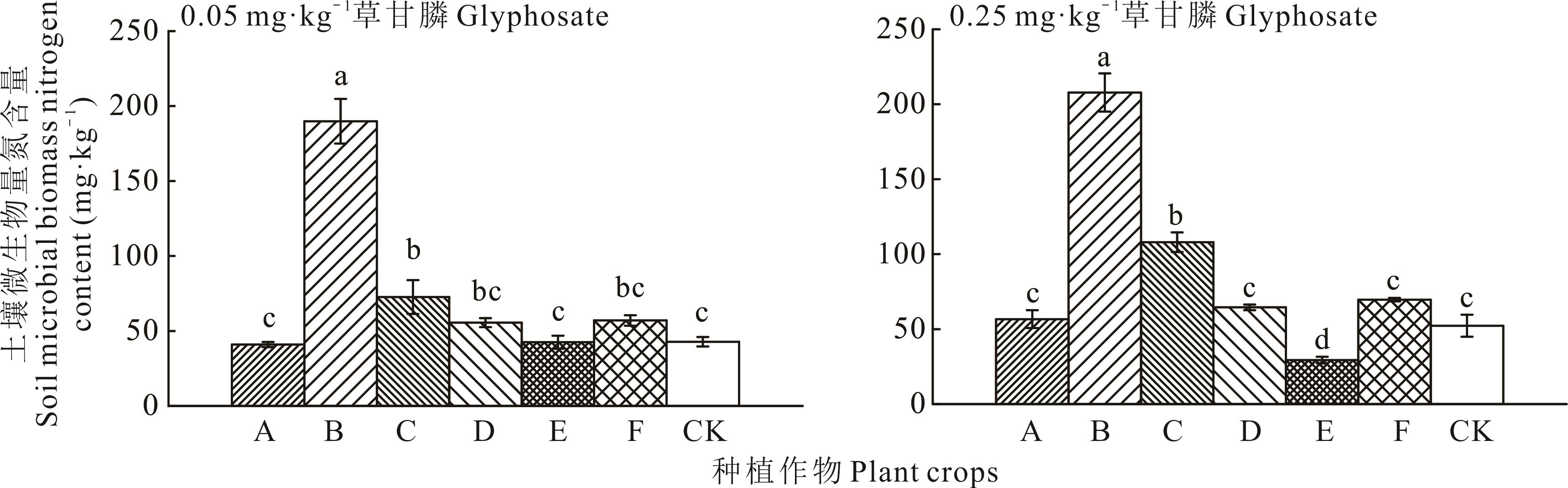
图3 种植作物对草甘膦残留土壤微生物量氮的影响
Fig.3 The effects of plant crops on microbial biomass nitrogen in glyphosate-residual soil
指标 Index | 变异来源 Source of variation | 平方和 Sum of squares | 自由度 Degree of freedom | 均方 Mean square | F值 F value |
|---|---|---|---|---|---|
土壤微生物量碳 Soil microbial biomass carbon | 植物类型Plant type | 64642.85 | 6 | 10773.81*** | 15.51 |
| 农药浓度Pesticide concentration | 4327.15 | 1 | 4327.15* | 6.23 | |
植物类型×农药浓度 Plant type×pesticide concentration | 28956.41 | 6 | 4826.07*** | 6.95 | |
土壤微生物量氮 Soil microbial biomass nitrogen | 植物类型Plant type | 113048.91 | 6 | 18841.49*** | 124.50 |
| 农药浓度Pesticide concentration | 1619.20 | 1 | 1619.20** | 10.70 | |
植物类型×农药浓度 Plant type×pesticide concentration | 1860.65 | 6 | 310.11ns | 2.05 |
表1 种植作物降解草甘膦后对土壤微生物量碳氮影响的多因素分析
Table 1 Multifactorial analysis of plant crops on soil microbial carbon and nitrogen after the degradation of glyphosate
指标 Index | 变异来源 Source of variation | 平方和 Sum of squares | 自由度 Degree of freedom | 均方 Mean square | F值 F value |
|---|---|---|---|---|---|
土壤微生物量碳 Soil microbial biomass carbon | 植物类型Plant type | 64642.85 | 6 | 10773.81*** | 15.51 |
| 农药浓度Pesticide concentration | 4327.15 | 1 | 4327.15* | 6.23 | |
植物类型×农药浓度 Plant type×pesticide concentration | 28956.41 | 6 | 4826.07*** | 6.95 | |
土壤微生物量氮 Soil microbial biomass nitrogen | 植物类型Plant type | 113048.91 | 6 | 18841.49*** | 124.50 |
| 农药浓度Pesticide concentration | 1619.20 | 1 | 1619.20** | 10.70 | |
植物类型×农药浓度 Plant type×pesticide concentration | 1860.65 | 6 | 310.11ns | 2.05 |
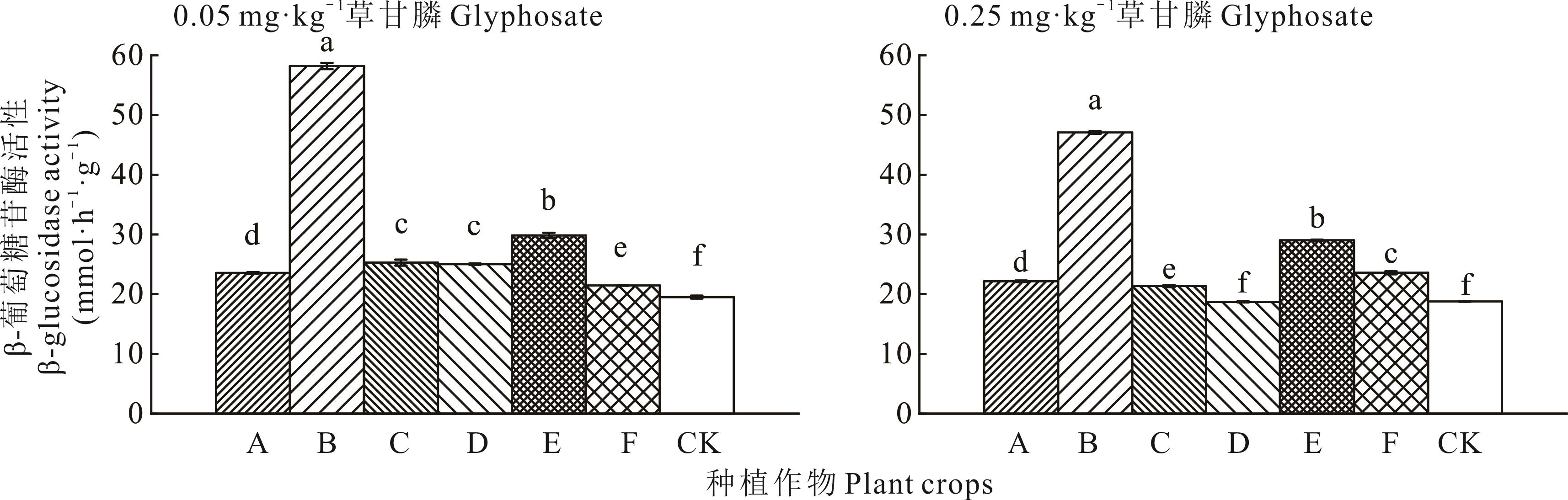
图4 种植作物对草甘膦残留土壤β-葡萄糖苷酶活性的影响
Fig.4 The effects of plant crops on β-glucosidase activity in glyphosate-residual soil
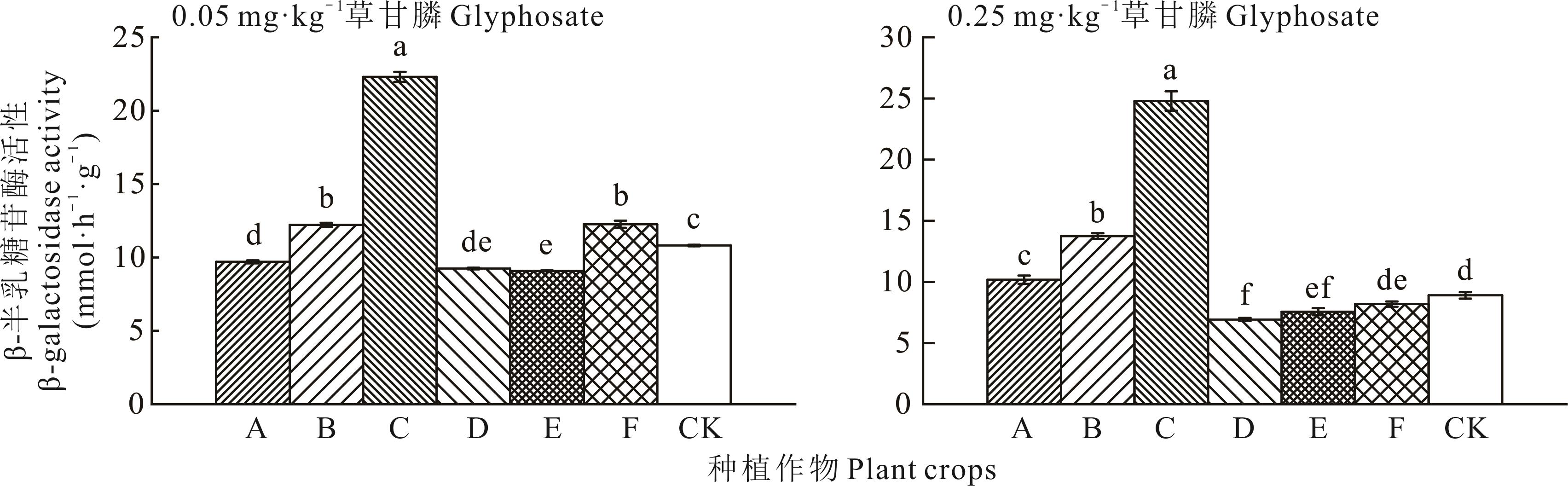
图5 种植作物对草甘膦残留土壤 β-半乳糖苷酶活性的影响
Fig.5 The effects of plant crops on the β-galactosidase activity in glyphosate-residual soil
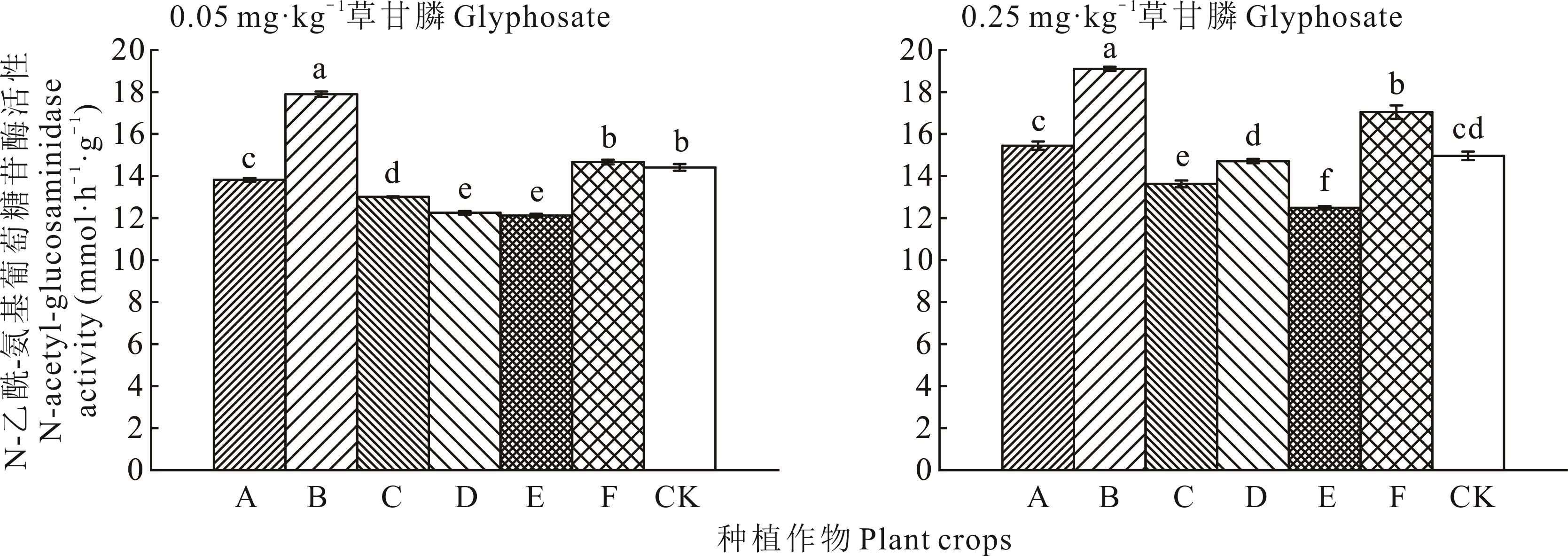
图6 种植作物对草甘膦残留土壤N-乙酰-氨基葡萄糖苷酶活性的影响
Fig.6 The effects of plant crops on the N-acetylglucosaminidase activity in glyphosate-residual soil
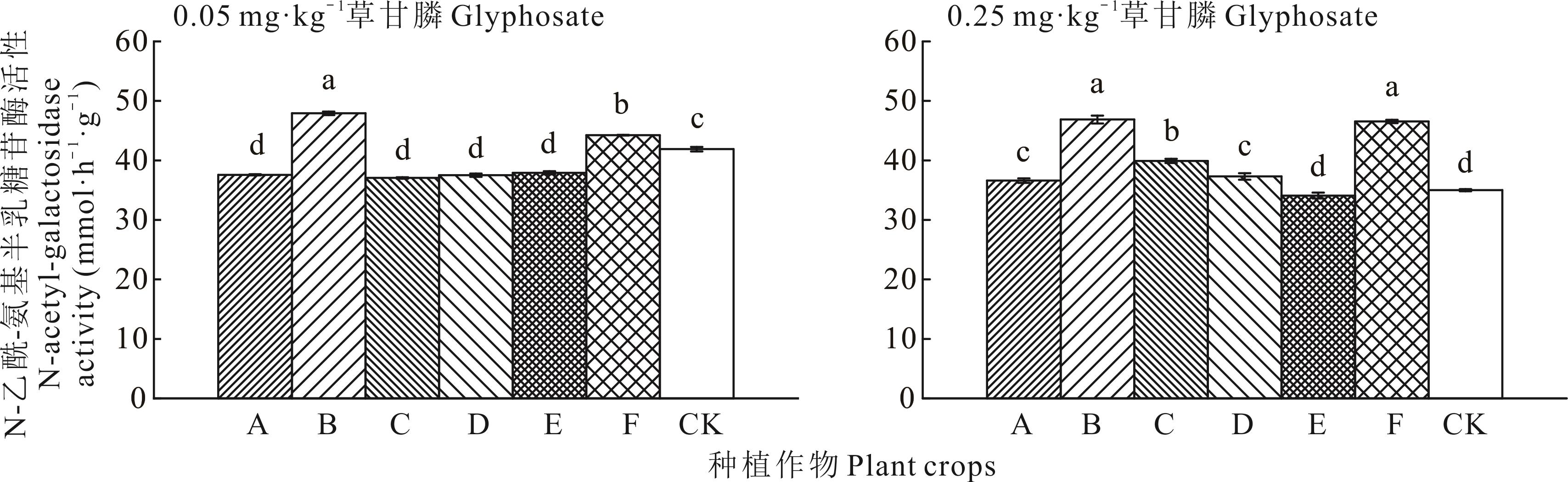
图7 种植作物对草甘膦残留土壤N-乙酰-氨基半乳糖苷酶活性的影响
Fig.7 The effects of plant crops on the N-acetyl-galactosidase activity in glyphosate-residual soil

图8 种植作物对草甘膦残留土壤碱性磷酸酶活性的影响
Fig.8 The effects of plant crops on the alkaline phosphatase activity in glyphosate-residual soil
| [1] | Wang B. Screening, identification and key substance analysis of glyphosate degrading bacteria. Changchun: Jilin Agricultural University, 2021. |
| 王冰. 草甘膦降解菌的筛选、鉴定及关键物质分析. 长春: 吉林农业大学, 2021. | |
| [2] | Maggi F, Cecilia D L, Tang F H M, et al. The global environmental hazard of glyphosate use. Science of the Total Environment, 2020, 717: 137-167. |
| [3] | Liu T, Jiang H Z, Zhang H S, et al. Research progress on animals toxicity of glyphosate. China Animal Husbandry & Veterinary Medicine, 2023, 50(7): 3026-3033. |
| 刘田, 江海圳, 张海森, 等. 草甘膦动物毒性的研究进展. 中国畜牧兽医, 2023, 50(7): 3026-3033. | |
| [4] | Zhang Y, Dai Q H, Yan Y J, et al. Research progress on the impact of glyphosate herbicide application on soil quality. Journal of Soil and Water Conservation, 2023, 37(4): 7-13. |
| 张友, 戴全厚, 严友进, 等. 施用草甘膦除草剂对土壤质量影响的研究进展. 水土保持学报, 2023, 37(4): 7-13. | |
| [5] | Tong M M, Gao W J, Jiao W T, et al. The uptake, translocation, metabolism and distribution of glyphosate in non-target tea plant (Camellia sinensis L.). Journal of Agricultural & Food Chemistry, 2017, 65(35): 7638-7646. |
| [6] | Hu L, He W X, Wang X D, et al. Effect of glyphosate on soil enzyme. Journal of Agro-Environment Science, 2009, 28(4): 680-685. |
| 呼蕾, 和文祥, 王旭东, 等. 草甘膦的土壤酶效应研究. 农业环境科学学报, 2009, 28(4): 680-685. | |
| [7] | Liu R J, Zhao Y, Wang Y H, et al. Research progress of organophosphorus pesticide residues status and removal methods. The Food Industry, 2019, 40(9): 299-302. |
| 刘仁杰, 赵悦, 王玉华, 等. 有机磷农药残留现状及去除方法的研究进展. 食品工业, 2019, 40(9): 299-302. | |
| [8] | Zuo J H. Comparative study on the value of atropine and pralidoxime in pre-hospital emergency treatment of organophosphorus pesticide poisoning (SAOPP). Cardiovascular Disease Electronic Journal of Integrated Traditional Chinese and Western Medicine, 2020, 8(16): 177-178. |
| 左继华. 对比研究阿托品、解磷定院前急救有机磷农药中毒(SAOPP)的价值. 中西医结合心血管病电子杂志, 2020, 8(16): 177-178. | |
| [9] | Tarazona J V, Court-Marques D, Tiramani M, et al. Glyphosate toxicity and carcinogenicity: a review of the scientific basis of the European Union assessment and its differences with IARC. Archives of Toxicology, 2017, 91(8): 2723-2743. |
| [10] | George J, Prasad S, Mahmood Z, et al. Studies on glyphosate-induced carcinogenicity in mouse skin: A proteomic approach. Journal of Proteomics, 2010, 73(5): 951-964. |
| [11] | Myers J P, Antoniou M N, Blumberg B, et al. Concerns over use of glyphosate-based herbicides and risks associated with exposures: a consensus statement. Environmental Health, 2016, 15(1): 19. |
| [12] | Chirakkara R A, Cameselle C, Reddy K R. Assessing the applicability of phytoremediation of soils with mixed organic and heavy metal contaminants. Reviews in Environmental Science and Bio-technology, 2016, 15(2): 299-326. |
| [13] | Cindy P, Martin P. The impact and toxicity of glyphosate and glyphosate-based herbicides on health and immunity. Journal of Immunotoxicology, 2020, 17(1): 163-174. |
| [14] | Roos A J D, Aaron B, Rusiecki J A, et al. Cancer incidence among glyphosate-exposed pesticide applicators in the agricultural health study. Environmental Health Perspectives, 2005, 113(1): 49-54. |
| [15] | Zhang B W, Li F P, Xu Y L. The improvement effects of 10 herbaceous plants on soil of stony mining spoils. Jiangsu Agricultural Sciences, 2018, 46(21): 286-290. |
| 张博文, 李富平, 许永利. 10种草本植物对石矿迹地土壤的改良效果. 江苏农业科学, 2018, 46(21): 286-290. | |
| [16] | Li Z J, Ma G R. The mechanism of phytoremediation of soil contaminated by organic pollutants. Chinese Journal of Soil Science, 2005, 36(3): 436-439. |
| 李兆君, 马国瑞. 有机污染物污染土壤环境的植物修复机理. 土壤通报, 2005, 36(3): 436-439. | |
| [17] | Wang J F, Xing S Z, Duan L Z, et al. Effects using hybrid sudan grass (Sorghum bicolor×S. sudanense) to remediate DDT and its main degradation product in contaminated soil. Acta Prataculturae Sinica, 2006, 15(6): 77-80. |
| 汪建飞, 邢素芝, 段立珍, 等. 杂交苏丹草修复DDT及其主要降解产物污染土壤效果研究. 草业学报, 2006, 15(6): 77-80. | |
| [18] | Zhang S Q. Study on degradation of organochlorine pesticides in rhizosphere soil of garden plants by root exudates. Environmental Science & Technology, 2022, 45(1): 145-153. |
| 张淑琴. 月季根系分泌物促进根际土壤有机氯农药降解研究. 环境科学与技术, 2022, 45(1): 145-153. | |
| [19] | Liu H L. Effects of glyphosate-resistant transgenic soybean on soil microbe and enzyme activity. Taiyuan: Shanxi University, 2019. |
| 刘慧璐. 抗草甘膦转基因大豆对土壤微生物和酶活性的影响. 太原: 山西大学, 2019. | |
| [20] | Peng N N. Divergence of soil microbial biomass carbon and nitrogen and its influencing factors in Chongming Dongtan wetland. Shanghai: East China Normal University, 2022. |
| 彭娜娜. 崇明东滩湿地土壤微生物生物量碳氮分异及影响因素分析. 上海: 华东师范大学, 2022. | |
| [21] | Lin J J, Zhu B, Cheng W X. Decadally cycling soil carbon is more sensitive to warming than faster-cycling soil carbon. Global Change Biology, 2015, 21(12): 4602-4612. |
| [22] | Cheng F, Peng X B, Zhao P, et al. Soil microbial biomass, basal respiration and enzyme activity of main forest types in the Qinling mountains. PLoS One, 2013, 8(6): e67353. |
| [23] | Hu Y B, Liang C F, Jin J, et al. Effects of long-term sod cultivation on Chinese hickory plantation soil fungal community and enzyme activities. Environmental Science, 2023, 44(5): 2945-2954. |
| 胡颖槟, 梁辰飞, 金锦, 等. 长期生草栽培对山核桃人工林土壤真菌群落和酶活性的影响. 环境科学, 2023, 44(5): 2945-2954. | |
| [24] | Yang J H, Wang C L, Dai H L. Soil chemical analysis and environmental monitoring. Beijing: China Land Press, 2008. |
| 杨剑虹, 王成林, 代亨林. 土壤农化分析与环境监测. 北京: 中国大地出版社, 2008. | |
| [25] | Nanjing Institute of Environmental Sciences, Ministry of Ecology and Environment. Determination of glyphosate in soil and sediment-high performance liquid chromatography: HJ 1055-2019. Jiangsu: China Environmental Publishing Group, 2019. |
| 生态环境部南京环境科学研究所. 土壤和沉积物 草甘膦的测定 高效液相色谱法: HJ 1055-2019. 江苏: 中国环境出版集团, 2019. | |
| [26] | Vance E D, Brookes P C, Jenkinson D S. An extraction method for measuring soil microbial biomass C. Soil Biology & Biochemistry, 1987, 19(6): 703-707. |
| [27] | Brookes P C, Landman A, Pruden G J, et al. Chloroform fumigation and the release of soil nitrogen: A rapid direct extraction method for measuring microbial biomass nitrogen in soil. Soil Biology & Biochemistry, 1985, 17(6): 837-842. |
| [28] | Steinweg M J, Dukes S J, Wallenstein D M. Modeling the effects of temperature and moisture on soil enzyme activity: Linking laboratory assays to continuous field data. Soil Biology and Biochemistry, 2012, 55(1): 85-92. |
| [29] | Bai D S, Wang Y W, Yang X, et al. Effects of long-term (10 years) remediation of Caragana on soil enzyme activities, heavy metals, microbial diversity and metabolic spectrum of coal gangue. Ecological Engineering, 2022, 181(1): 106679. |
| [30] | Liu J, Li Y L, Ke L. Effects of maize and soybean phytoremedying petroleum polluted acid soil. Journal of Ecology and Rural Environment, 2012, 28(3): 300-304. |
| 刘健, 李妍丽, 柯林. 玉米和黄豆对酸性土壤中石油的去除效果. 生态与农村环境学报, 2012, 28(3): 300-304. | |
| [31] | Liu C M, McLean P A, Sookdeo C C, et al. Degradation of the herbicide glyphosate by members of the family rhizobiaceae. Applied and Environmental Microbiology, 1991, 57(6): 1799-1804. |
| [32] | Zhang F J, He J, Lü C W, et al. Accumulation of aged HCH-DDT by corn (Zea mays L.) and wheat (Triticum aestivum L.) roots from soils. Journal of Agro-Environment Science, 2014, 33(7): 1265-1272. |
| 张福金, 何江, 吕昌伟, 等. 作物根系对土壤中老化HCH-DDT的富集作用. 农业环境科学学报, 2014, 33(7): 1265-1272. | |
| [33] | Xu Y C, Shen Q R, Ran W. Effects of zero-tillage and application of manure on soil microbial biomass C, N and P after sixteen years of cropping. Acta Pedologica Sinica, 2002, 39(1): 89-96. |
| 徐阳春, 沈其荣, 冉炜. 长期免耕与施用有机肥对土壤微生物生物量碳、氮、磷的影响. 土壤学报, 2002, 39(1): 89-96. | |
| [34] | Sun G D. Biological characteristics and biodegradation of organochlorine pesticides in contaminated soils. Beijing: Tsinghua University, 2015. |
| 孙广东. 有机氯农药污染土壤生物学特性及降解效应研究. 北京: 清华大学, 2015. | |
| [35] | Kong P J, Zheng J, Luan L, et al. Effects of different types of straw returning on the bacterial community, organic carbon mineralization and maize yield in upland red soil. Environmental Science, 2021, 42(12): 6047-6057. |
| 孔培君, 郑洁, 栾璐, 等. 不同秸秆还田方式对旱地红壤细菌群落、有机碳矿化及玉米产量的影响. 环境科学, 2021, 42(12): 6047-6057. | |
| [36] | Liu Y L, Qian H Y, Zhang X, et al. Impacts of arbuscular mycorrhizal fungi (AMF) on growth, N bio-fixation, and phosphorus uptake of legume crop. Chinese Journal of Applied Ecology, 2021, 32(5): 1761-1767. |
| 刘云龙, 钱浩宇, 张鑫, 等. 丛枝菌根真菌对豆科作物生长和生物固氮及磷素吸收的影响. 应用生态学报, 2021, 32(5): 1761-1767. |
| [1] | 刘畅, 陈积山, 朱瑞芬, 孙万斌, 姚博, 董世魁. 有机肥和生物炭添加对亚热带人工草地土壤微生物碳、磷限制的缓解作用[J]. 草业学报, 2026, 35(4): 54-66. |
| [2] | 张颖, 贺善睦, 何傲蕾, 李昌宁, 姚拓. 微生物菌剂与有机钙蛋白配施对紫花苜蓿生长和土壤酶活性的影响[J]. 草业学报, 2026, 35(1): 25-39. |
| [3] | 汤珊珊, 胡敏. 禾本科植物根际土壤酶活性和细菌群落结构差异[J]. 草业学报, 2025, 34(8): 99-108. |
| [4] | 贾蕴欢, 胡雯颖, 邓健, 赵雪, 陈子玥, 王亚楠, 李江文, 张晓曦. 氮添加对黄土丘陵区草地土壤微生物养分限制特征的影响[J]. 草业学报, 2025, 34(2): 221-232. |
| [5] | 欧翔, 连海, 陈荣强, 邱静芸, 吴丽娟, 操贤洪, 张强, 雷小文. 不同施肥处理种植王草后对稀土尾矿土壤理化性质和酶活性的影响[J]. 草业学报, 2025, 34(2): 94-108. |
| [6] | 赵文军, 梁婷, 王剑松, 刘魁, 冯瑜, 王正旭, 徐梓荷, 朱云聪, 孙蒙猛, 李湘伟, 付利波, 尹梅, 周国朋, 陈华, 曹卫东. 种植翻压光叶紫花苕配合氮肥减施提高烤烟产量和土壤质量[J]. 草业学报, 2025, 34(10): 74-84. |
| [7] | 姚佳妮, 刘爽, 张钧杰, 胡明珠, 代金霞. 宁夏荒漠草原典型灌丛根际土壤酶活性及微生物代谢多样性[J]. 草业学报, 2024, 33(9): 1-14. |
| [8] | 张婷婷, 刘宇乐, 陈红, 许凌欣, 陈祥伟, 王恩姮, 严俊鑫. 不同外源物质对盐、碱及干旱胁迫下草木樨种子萌发、幼苗生长及生理的影响[J]. 草业学报, 2024, 33(8): 122-132. |
| [9] | 李思媛, 孙宗玖, 于冰洁, 周晨烨, 周磊, 郑丽, 刘慧霞, 冶华薇. 封育对伊犁绢蒿荒漠草地土壤碳氮磷、酶活性及其化学计量特征的影响[J]. 草业学报, 2024, 33(7): 25-40. |
| [10] | 张俊豪, 柴雪茹, 马嵩科, 张冬霞, 张静, 乔唱唱, 李爽, 黄明, 王贺正. 秸秆还田配施磷肥对豫西旱地小麦碳同化物积累的影响及其生理机制[J]. 草业学报, 2024, 33(6): 89-104. |
| [11] | 常单娜, 陈子英, 韩梅, 李正鹏, 严清彪, 吕帅磊, 周国朋, 孙小凤, 曹卫东. 毛叶苕子磷获取特征及根际特性的基因型差异[J]. 草业学报, 2024, 33(4): 122-134. |
| [12] | 高承芳, 桑雷, 孙世坤, 陈冬金, 王锦祥, 谢喜平. 饲粮中葛藤不同添加量对肉兔养分表观消化率、胃肠道发育及消化酶活性的影响[J]. 草业学报, 2024, 33(4): 199-209. |
| [13] | 黄琳曦, 陈倩, 张先言, 闫顺, 杨云, 辛培尧, 汪琼. 两种乔木凋落叶浸提液处理对地毯草土壤酶活性及其化学计量比的影响[J]. 草业学报, 2024, 33(4): 35-46. |
| [14] | 李秀芳, 魏文静, 蒲勇, 李廷轩, 叶代桦. 水蓼种植下猪粪处理土壤剖面磷组分与磷酸酶活性变化[J]. 草业学报, 2024, 33(3): 61-72. |
| [15] | 刘玉玲, 朱新霞, 吕新华, 孙辉. 雪莲SikCDPK1基因的表达特征和蛋白激酶活性分析[J]. 草业学报, 2023, 32(9): 213-221. |
| 阅读次数 | ||||||
|
全文 |
|
|||||
|
摘要 |
|
|||||
