

ISSN 1004-5759 CN 62-1105/S
草业学报 ›› 2027, Vol. 36 ›› Issue (1): 44-53.DOI: 10.11686/cyxb2026035
关欣怡( ), 夏琢真, 蔡小卜, 贺一凡, 孙娈姿()
收稿日期:2026-01-21
修回日期:2026-03-16
出版日期:2027-01-20
发布日期:2026-11-25
通讯作者:
孙娈姿
作者简介:E-mail: sunluanzi@163.com基金资助:
Xin-yi GUAN(), Zhuo-zhen XIA, Xiao-bo CAI, Yi-fan HE, Luan-zi SUN()
Received:2026-01-21
Revised:2026-03-16
Online:2027-01-20
Published:2026-11-25
Contact:
Luan-zi SUN
摘要:
干旱是限制牧草生产的主要非生物胁迫因素,自然条件下常以循环性干湿交替的水分波动形式存在,然而目前关于植物对循环干旱环境适应机制的研究仍相对不足。为此,以多年生黑麦草为研究对象,通过盆栽试验,设置正常供水对照组,以及轻度、中度和重度3个梯度的持续干旱与循环干旱处理,测定生物量分配、形态特征、非结构性碳水化合物(NSC)含量、碳稳定同位素(δ13C)和水分利用效率(WUE)等指标。结果表明,与持续干旱相比,循环干旱处理下植株受“干旱记忆”效应影响,根冠比显著提高,最大增幅达38.0%,有效增强水分获取能力;分蘖数进一步下降,而叶宽则有所增加,既减少无效耗水又保障光合面积;NSC分配呈现地上部优先积累的策略,为叶片光合功能的维持与复水后生长恢复提供物质支撑。随着干旱程度增加,持续干旱组黑麦草的δ13C值与WUE均显著上升,而循环干旱的δ13C值与WUE均低于同程度的持续干旱,其中WUE最大降幅为6.4%,反映其通过气孔动态调节实现了水分消耗与碳固定的协调平衡。综上所述,循环干旱胁迫下,黑麦草通过形态调整、生物量分配、地上部NSC积累以及气孔调节的协同策略,实现了循环干旱下生存与生长的动态平衡。本研究阐明了黑麦草适应循环干旱的核心机制,为干旱频发地区黑麦草的栽培与管理提供了理论依据。
关欣怡, 夏琢真, 蔡小卜, 贺一凡, 孙娈姿. 循环干旱胁迫下黑麦草碳分配策略与水分利用效率的适应性机制[J]. 草业学报, 2027, 36(1): 44-53.
Xin-yi GUAN, Zhuo-zhen XIA, Xiao-bo CAI, Yi-fan HE, Luan-zi SUN. Carbon allocation strategy and water use efficiency adaptive mechanisms in ryegrass under cyclic drought stress[J]. Acta Prataculturae Sinica, 2027, 36(1): 44-53.
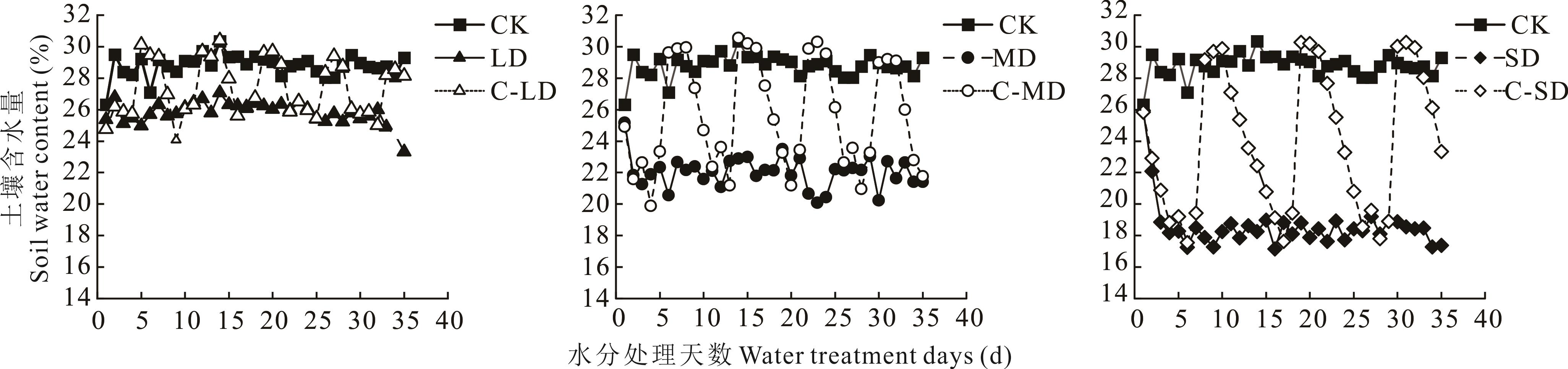
图1 不同干旱处理下土壤含水量变化CK: 对照组Control group; LD: 持续性轻度干旱Prolonged light drought; MD: 持续性中度干旱Prolonged moderate drought; SD: 持续性重度干旱Prolonged severe drought; C-LD: 循环性轻度干旱Cyclic light drought; C-MD: 循环性中度干旱Cyclic moderate drought; C-SD: 循环性重度干旱Cyclic severe drought. 下同The same below.
Fig.1 Changes of soil daily average water content under different drought treatments
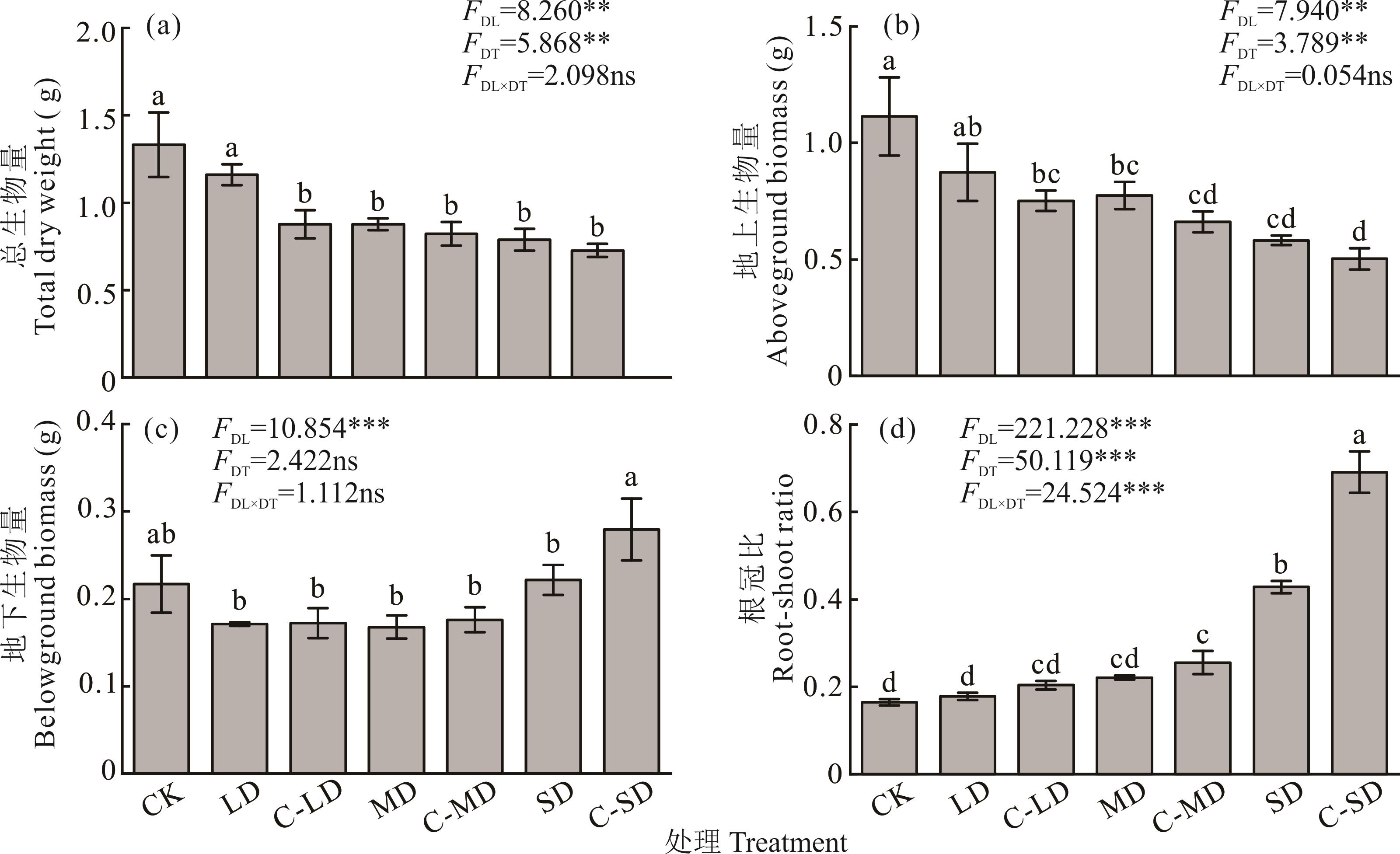
图2 不同干旱处理下多年生黑麦草的生物量和根冠比不同小写字母表示不同处理间差异显著(P<0.05)。Different lowercase letters indicate significant differences among different treatments at the 0.05 level. DL: 干旱程度Drought levels; DT: 干旱方式Drought patterns. *: P<0.05; **: P<0.01; ***: P<0.001; ns为无统计学差异。ns refers to no significance. 下同The same below.
Fig.2 Biomass and root-shoot ratio in perennial ryegrass under different drought treatments
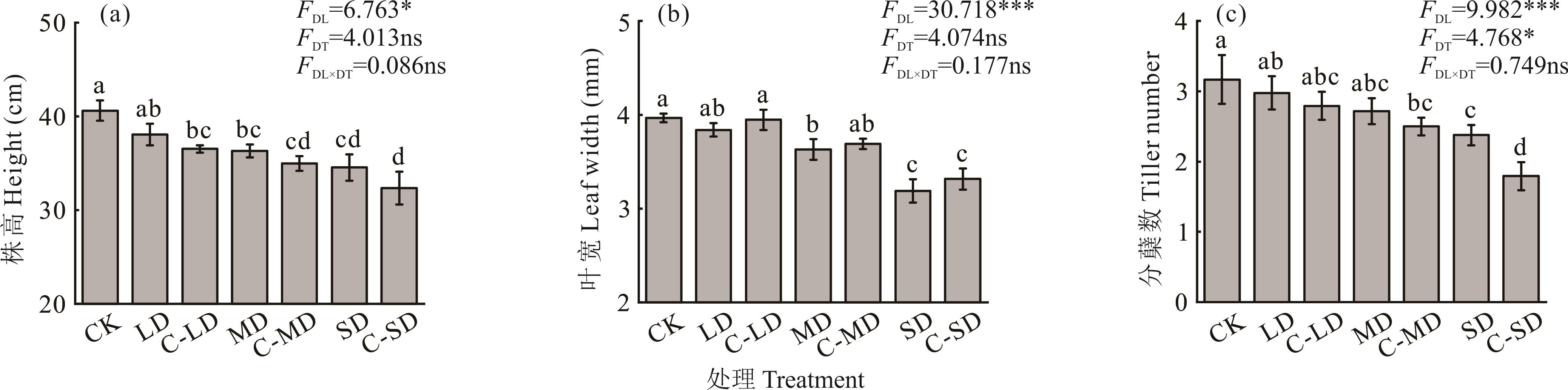
图3 不同干旱处理下多年生黑麦草的生长形态特征
Fig.3 Growth morphology in perennial ryegrass under different drought treatments
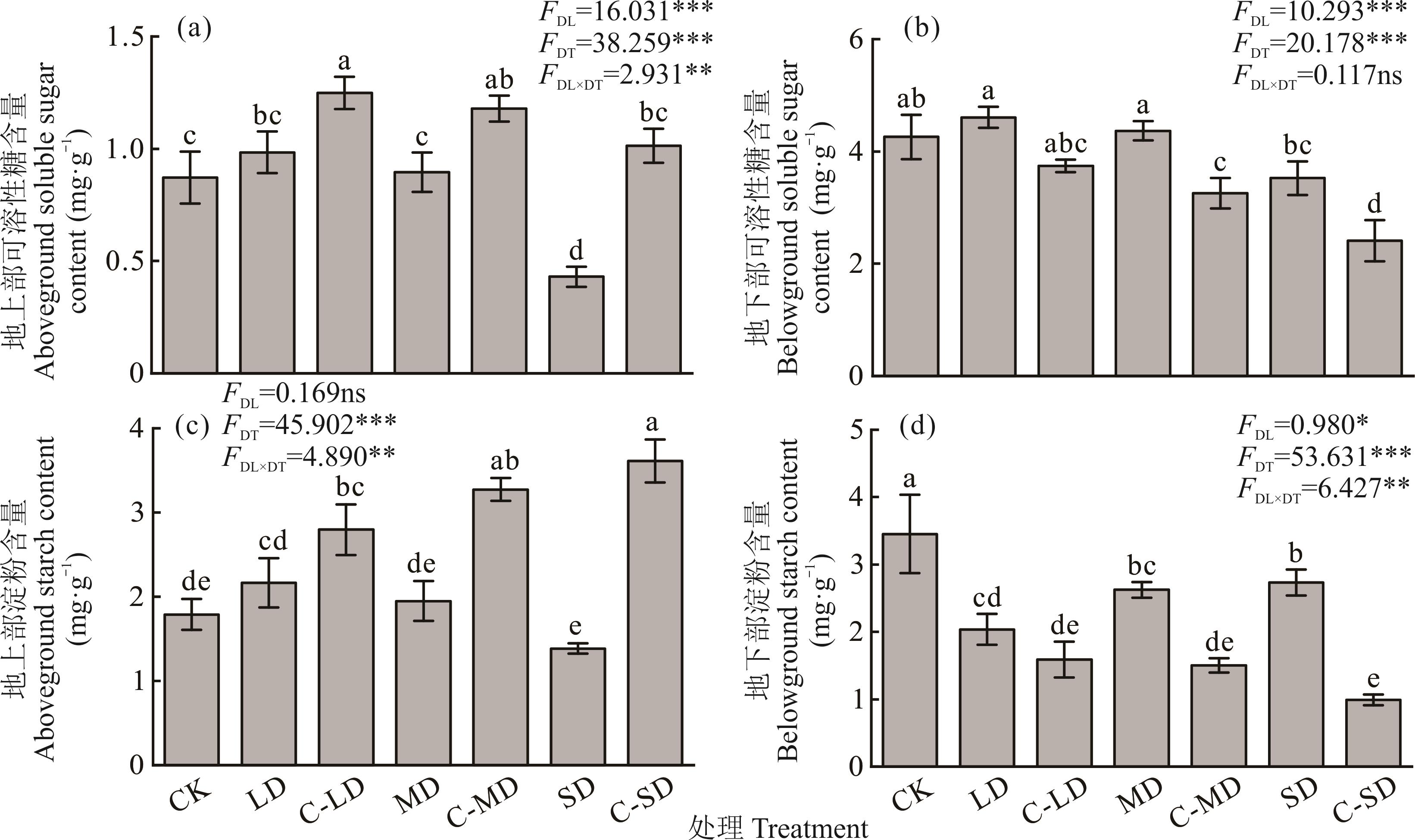
图4 不同干旱处理下多年生黑麦草的可溶性糖和淀粉含量
Fig.4 Soluble sugar and starch concentration in perennial ryegrass under different drought treatments
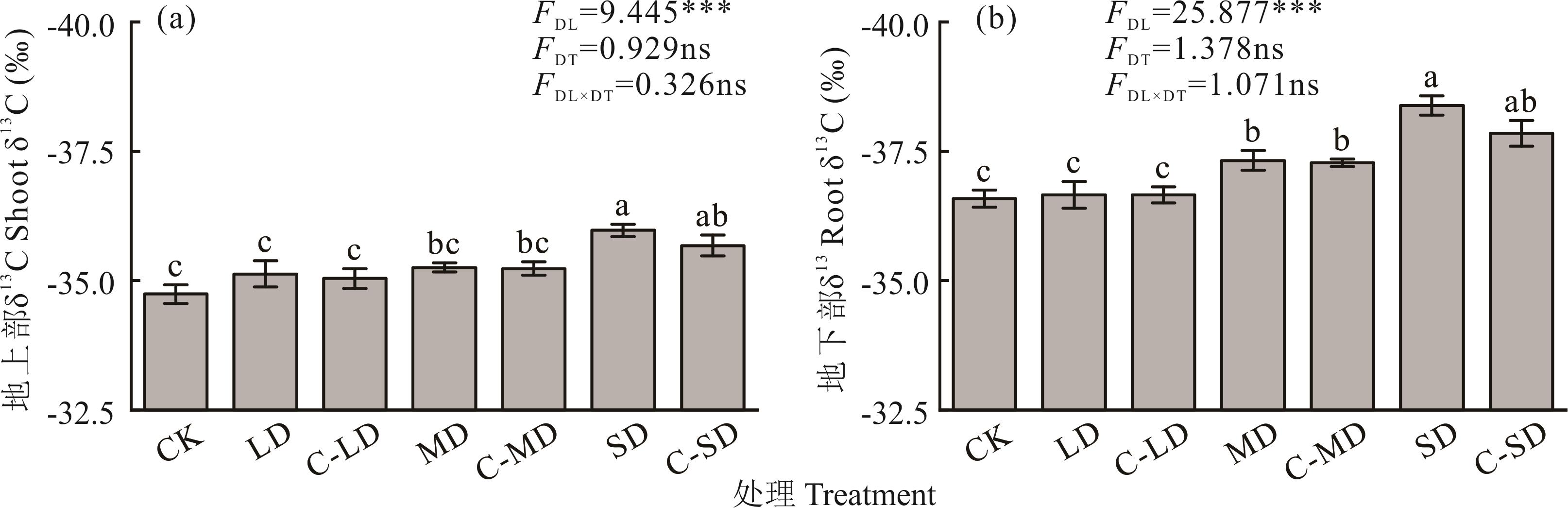
图5 不同干旱处理下多年生黑麦草δ13C值的变化
Fig.5 Changes of δ13C values in perennial ryegrass under different drought treatments
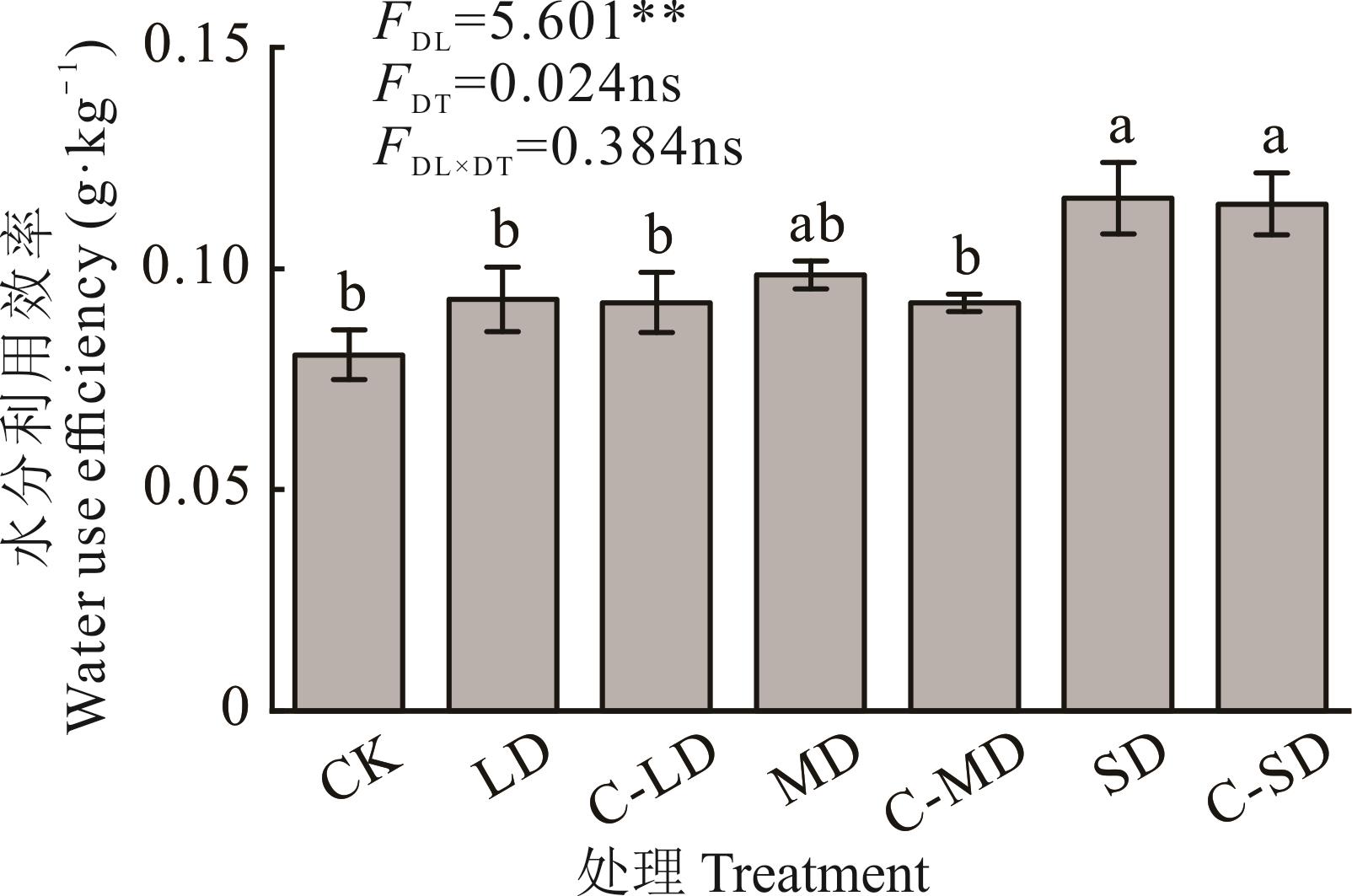
图6 不同干旱处理下多年生黑麦草的水分利用效率的变化
Fig.6 Changes of water use efficiency in perennial ryegrass under different drought treatments
| [1] | Su Z G, Han Y J, Zhai Y J, et al. Research progress on stress resistance of Lolium plant. China Herbivore Science, 2024, 44(5): 71-76. |
| 苏志刚, 韩有健, 翟亚军, 等. 黑麦草属植物抗逆性研究进展. 中国草食动物科学, 2024, 44(5): 71-76. | |
| [2] | Othman D B, Abida H. Monitoring and mapping of drought in a semi-arid region: case of the Merguellil watershed, central Tunisia. Environmental Monitoring and Assessment, 2022, 194(4): DOI: 10.1007/s10661-022-09926-5. |
| [3] | Wu J X, Zeng R Q, Yin H L, et al. Mechanisms of plant response to water stress. Modern Agriculture Research, 2024, 30(10): 64-68. |
| 吴佳芯, 曾冉琦, 尹会兰, 等. 植物对水分胁迫的响应机制. 现代农业研究, 2024, 30(10): 64-68. | |
| [4] | Galviz Y C F, Ribeiro R V, Souza G M. Yes, plants do have memory. Theoretical and Experimental Plant Physiology, 2020, 32(3): 195-202. |
| [5] | Li F, Sun M W, Zhong S Z, et al. Photosynthetic physiology and growth adaptation of herbages with different photosynthetic pathways in response to drought-rehydration. Chinese Journal of Plant Ecology, 2022, 46(1): 74-87. |
| 李斐, 孙明伟, 钟尚志, 等. 不同光合类型牧草对干旱-复水的光合生理响应及生长适应策略. 植物生态学报, 2022, 46(1): 74-87. | |
| [6] | Okami M, Kato Y, Kobayashi N, et al. Morphological traits associated with vegetative growth of rice (Oryza sativa L.) during the recovery phase after early-season drought. European Journal of Agronomy, 2015, 64: 58-66. |
| [7] | Vilonen L, Ross M, Smith M D. What happens after drought ends: Synthesizing terms and definitions. New Phytologist, 2022, 235(2): 420-431. |
| [8] | Guo T T, Tian C, Chen C Y, et al. Growth and carbohydrate dynamic of perennial ryegrass seedlings during PEG-simulated drought and subsequent recovery. Plant Physiology and Biochemistry, 2020, 154: 85-93. |
| [9] | Zhao C C. Study on physiological response mechanism of perennial ryegrass to drought stress. Yantai: Ludong University, 2020. |
| 赵春程. 多年生黑麦草干旱胁迫生理应答机理研究. 烟台: 鲁东大学, 2020. | |
| [10] | Gao S, Lin G Y, Sun H, et al. Effects of drought and rehydration on root growth in early seedling of Glycyrrhiza uralensis Fisch. Journal of Northeast Normal University (Natural Science Edition), 2025, 57(2): 104-108. |
| 高嵩, 林广宇, 孙航, 等. 干旱胁迫及复水对甘草早期实生苗根系生长的影响. 东北师大学报(自然科学版), 2025, 57(2): 104-108. | |
| [11] | Dong W H, Wang Y X, Xie T T, et al. Effects of drought and rehydration on non-structural carbohydrates of Salsola passerina Bunge seedlings. Acta Agrestia Sinica, 2025, 33(6): 1807-1816. |
| 董维红, 王雲霞, 解婷婷, 等. 干旱-复水对珍珠猪毛菜幼苗非结构性碳水化合物的影响. 草地学报, 2025, 33(6): 1807-1816. | |
| [12] | Xiao L, Liu G B, Li P, et al. Responses of photosynthesis and non-structural carbohydrates of Bothriochloa ischaemum to doubled CO2 concentration and drought stress. Journal of Plant Nutrition and Fertilizer, 2017, 23(2): 389-397. |
| 肖列, 刘国彬, 李鹏, 等. 白羊草光合特性及非结构性碳水化合物含量对CO2浓度倍增和干旱胁迫的响应. 植物营养与肥料学报, 2017, 23(2): 389-397. | |
| [13] | Zhang C, Peng X, Guo X F, et al. Transcriptional and physiological data reveal the dehydration memory behavior in switchgrass (Panicum virgatum L.). Biotechnology for Biofuels, 2018, 11: 91. |
| [14] | Liu Q H, Rasmussen S, Johnson L J, et al. Molecular mechanisms regulating carbohydrate metabolism during Lolium perenne regrowth vary in response to nitrogen and gibberellin supply. Journal of Plant Growth Regulation, 2020, 39(3): 1332-1345. |
| [15] | Sadhukhan A, Prasad S S, Mitra J, et al. How do plants remember drought? Planta, 2022, 256(1): DOI: 10.1007/s00425-022-03924-0. |
| [16] | Jin S Y, Peng Z D, Zhang S L. The impact of varying degrees of drought stress and rehydration treatment on the physiological indicators of Robinia pseudoacacia seedling. Journal of Northeast Forestry University, 2024, 52(10): 27-39. |
| 金思雨, 彭祚登, 张舒乐. 不同程度干旱胁迫和复水处理对刺槐苗木生理指标的影响. 东北林业大学学报, 2024, 52(10): 27-39. | |
| [17] | Yong J Y, Ma S, Ma F H, et al. Effects of drought stress and rehydration on biomass allocation and osmotic regulation characteristics of Indigofera bungeana. Acta Prataculturae Sinica, 2025, 34(7): 158-170. |
| 雍嘉仪, 马霜, 马风华, 等. 干旱及复水对河北木蓝生物量分配与渗透调节特征的影响. 草业学报, 2025, 34(7): 158-170. | |
| [18] | Xing J Y, Li L, Wang C, et al. Effects of nitrogen level and rewatering degree after drought priming on water use efficiency of wheat. Agricultural Research in the Arid Areas, 2022, 40(5): 52-61. |
| 邢佳伊, 李丽, 王超, 等. 施氮水平和干旱锻炼后复水程度对小麦水分利用效率的影响. 干旱地区农业研究, 2022, 40(5): 52-61. | |
| [19] | Chen Y Q, Chen S R, Shao X R, et al. Review on plant water use efficiency and its influencing factors based on stable isotope. Journal of Mountain Agriculture and Biology, 2025, 44(1): 21-29. |
| 陈应群, 陈世仁, 邵雪蓉, 等. 基于稳定碳同位素的植物水分利用效率及其影响因素研究. 山地农业生物学报, 2025, 44(1): 21-29. | |
| [20] | Li L, Ma H Y, Xing J Y, et al. Effects of water deficit and nitrogen application on leaf gas exchange, phytohormone signaling, biomass and water use efficiency of oat plants. Journal of Plant Nutrition and Soil Science, 2020, 183(6): 695-704. |
| [21] | He P J, Sun A N, Li L, et al. Effects of drought stress and rehydration on photosynthetic characteristics, quality and yield of soybean leaves. Chinese Journal of Ecology, (2025-09-23)[2026-01-21]. https://link.cnki.net/urlid/21.1148.Q.20250923.1609.017. |
| 何佩瑾, 孙安妮, 李琳, 等. 干旱胁迫和复水对大豆叶片光合特性及品质产量的影响. 生态学杂志, (2025-09-23)[2026-01-21]. https://link.cnki.net/urlid/21.1148.Q.20250923.1609.017. | |
| [22] | Yang Y H. Mechanisms underlying the different responses of photosynthesis and water transport to drought between rice and wheat. Wuhan: Huazhong Agricultural University, 2024. |
| 杨裕涵. 干旱胁迫对水稻和小麦光合作用与水分传输能力的影响差异和机理研究. 武汉: 华中农业大学, 2024. | |
| [23] | Wu X R, Zhao Q X, Cai Y M, et al. Effect of drought-rewatering on leaf water potential and stomatal opening and closing in Broussonetia papyrifera. Acta Agrestia Sinica, 2023, 31(3): 769-776. |
| 吴学蕤, 赵庆霞, 蔡银美, 等. 干旱-复水对构树叶片水势和气孔开闭的影响. 草地学报, 2023, 31(3): 769-776. | |
| [24] | Landhausser S M, Chow P S, Dickman L T, et al. Standardized protocols and procedures can precisely and accurately quantify non-structural carbohydrates. Tree Physiology, 2018, 38(12): 1764-1778. |
| [25] | Dawson T E, Mambelli S, Plamboeck A H, et al. Stable isotopes in plant ecology. Annual Review of Ecology and Systematics, 2002, 33: 507-559. |
| [26] | Li J N, Feng G L, Liu H X, et al. The response of irrigation volume and phosphorus application amount to water use efficiency of alfalfa. Pratacultural Science, (2025-07-24)[2026-01-21]. https://link.cnki.net/urlid/62.1069.S.20250724.1102.005. |
| 李婕娜, 冯甘霖, 刘慧霞, 等. 灌水量和施磷量互作对紫花苜蓿水分利用效率的调控效应. 草业科学, (2025-07-24)[2026-01-21]. https://link.cnki.net/urlid/62.1069.S.20250724.1102.005. | |
| [27] | Li Z S, Wan L Q, Li S, et al. Response of alfalfa root architecture and physiological characteristics to drought and rehydration. Acta Prataculturae Sinica, 2021, 30(1): 189-196. |
| 李振松, 万里强, 李硕, 等. 苜蓿根系构型及生理特性对干旱复水的响应. 草业学报, 2021, 30(1): 189-196. | |
| [28] | Auler P A, do Amaral M N. Marks that persist: DNA methylation in plant transgenerational memory and inheritance. Plant Physiology and Biochemistry, 2025, 229: 110680. |
| [29] | Jacques C, Salon C, Barnard R L, et al. Drought stress memory at the plant cycle level: A review. Plants-Basel, 2021, 10(9): 1873. |
| [30] | Bai Z A, Yang X Q, Zi N, et al. Drought stress memory enhances the tolerance of alfalfa Medicago sativa L. in response to a subsequent drought: A physiological and omics perspective. Environmental and Experimental Botany, 2025, 230: 106088. |
| [31] | Tian Z L, Lin K, Sun Y R, et al. Physiological and transcriptional analyses reveal formation of memory under recurring drought stresses in seedlings of cotton (Gossypium hirsutum). Plant Science, 2024, 338: 111920. |
| [32] | Li X M, Bao J T, Wang J, et al. Antecedent drought condition affects responses of plant physiology and growth to drought and post-drought recovery. Frontiers in Forests and Global Change, 2021, 4: DOI: 10.3389/ffgc.2021.704470. |
| [33] | Wang K, Pang Y Y, Lyu L Y, et al. Changes of non-structural carbohydrates of Populus×xiaozhuanica cv. Zhangwu seedlings during process of natural drought. Chinese Journal of Ecology, 2021, 40(7): 1969-1978. |
| 王凯, 逄迎迎, 吕林有, 等. 杨树幼苗自然干旱过程中非结构性碳水化合物变化. 生态学杂志, 2021, 40(7): 1969-1978. | |
| [34] | Ai Y, Liu H K, Yu L H, et al. Study on non-structural carbohydrate allocation strategies of psammophytes induced by drought stress in southeastern Xizang. Plant Science Journal, 2024, 42(5): 602-611. |
| 艾盈, 刘海坤, 于林宏, 等. 干旱胁迫下藏东南沙生植物非结构性碳水化合物分配策略研究. 植物科学学报, 2024, 42(5): 602-611. | |
| [35] | Zhao H, Han Z B, Yang Y T, et al. Effects of biochar on photosynthetic parameters and physiological characteristics of coffee seedlings under drought and rehydration conditions. Chinese Journal of Tropical Agriculture, 2025, 45(6): 43-50. |
| 赵颢, 韩泽邦, 杨云天, 等. 生物炭对干旱及复水处理下咖啡苗光合参数和生理特性的影响. 热带农业科学, 2025, 45(6): 43-50. | |
| [36] | Lai Z L, Zhan K B, Liao Z Q, et al. Stem hydraulic conductance, leaf photosynthesis, and carbon metabolism responses of cotton to short-term drought and rewatering. Agronomy-Basel, 2024, 14(1): 71. |
| [37] | Cui J Y. Study on the drought sensitivity and recovery of different genotypic maize under cyclical drought and rewatering. Zhengzhou: Henan Agricultural University, 2019. |
| 崔静宇. 周期性干旱复水下不同玉米品种水分敏感性与恢复能力研究. 郑州: 河南农业大学, 2019. | |
| [38] | Wu R N, Shi F L, Xu B. Medicago ruthenica (L.) Sojak. cv. Zhilixing response and adaptation strategy to drought stress and rehydration. Chinese Journal of Eco-Agriculture, 2020, 28(12): 1901-1912. |
| 乌日娜, 石凤翎, 徐舶. 直立型扁蓿豆对干旱胁迫和复水的响应及适应策略. 中国生态农业学报(中英文), 2020, 28(12): 1901-1912. |
| [1] | 臧家艺, 徐明杰, 谢济骋, 沈禹颖, 来兴发. 有机肥等氮替代化肥对旱作区青贮玉米/饲用大豆间作系统饲草产量和水分利用效率的影响[J]. 草业学报, 2026, 35(3): 83-95. |
| [2] | 代欣哲, 任文, 张伟, 陈文青, 张志新. 黄土高原半干旱区紫花苜蓿/黑麦草间作系统空间配置优化对水光利用的调控效应[J]. 草业学报, 2026, 35(12): 1-15. |
| [3] | 张译尹, 王斌, 王腾飞, 兰剑, 胡海英. 苜蓿种子田间作小黑麦对饲草产量、水分利用及苜蓿种子产量的影响[J]. 草业学报, 2025, 34(8): 43-53. |
| [4] | 郭彬, 罗维成, 单立山, 安宁, 刘冰. 模拟增温对河西走廊典型荒漠灌木光合作用的影响[J]. 草业学报, 2025, 34(7): 145-157. |
| [5] | 姚佳明, 郝欢欢, 张敬, 徐彬. tRNA-sgRNA/Cas9系统介导多年生黑麦草原生质体的基因编辑[J]. 草业学报, 2023, 32(4): 129-141. |
| [6] | 王茂鉴, 石薇, 常生华, 张程, 贾倩民, 侯扶江. 灌溉模式对河西灌区禾-豆间作系统饲草产量、品质和水分利用的影响[J]. 草业学报, 2023, 32(3): 13-29. |
| [7] | 卫宏健, 贺文员, 王越, 唐明, 陈辉. 丛枝菌根真菌与褪黑素对多年生黑麦草耐热性的影响[J]. 草业学报, 2023, 32(12): 126-138. |
| [8] | 姚佳明, 何悦, 郝欢欢, 黄心如, 张敬, 徐彬. 多年生黑麦草LpPIL5基因特征分析及转录调控[J]. 草业学报, 2022, 31(9): 155-167. |
| [9] | 高玮, 受娜, 蒋丛泽, 马仁诗, 沈禹颖, 杨宪龙. 施氮量对饲用高粱干物质积累、分配及水分利用效率的影响[J]. 草业学报, 2022, 31(9): 26-35. |
| [10] | 周大梁, 石薇, 蒋紫薇, 魏正业, 梁欢欢, 贾倩民. 沟垄集雨下密度和施氮对黄土高原青贮玉米叶片酶活性及水氮利用的影响[J]. 草业学报, 2022, 31(8): 126-143. |
| [11] | 牛伟玲, 陈辉, 侯慧新, 郭晨睿, 马娇林, 武建双. 10年禁牧未改变藏西北高寒荒漠植物水氮利用效率[J]. 草业学报, 2022, 31(8): 35-48. |
| [12] | 张晴, 邢静, 姚佳明, 殷庭超, 黄心如, 何悦, 张敬, 徐彬. 多年生黑麦草细胞分裂素信号通路B类ARR转录因子LpARR10的耐镉功能分析[J]. 草业学报, 2022, 31(5): 135-143. |
| [13] | 撖冬荣, 姚拓, 李海云, 黄书超, 杨琰珊, 高亚敏, 李昌宁, 张银翠. 微生物肥料与化肥减量配施对多年生黑麦草生长的影响[J]. 草业学报, 2022, 31(3): 136-143. |
| [14] | 陈林, 陈高路, 宋乃平, 李学斌, 万红云, 何文强. 宁夏东部荒漠草原猪毛蒿光合特征和水分利用效率对降水变化的响应[J]. 草业学报, 2022, 31(10): 87-98. |
| [15] | 赵利清, 彭向永, 刘俊祥, 毛金梅, 孙振元. GSH对铅胁迫下多年生黑麦草生长及光合生理的影响[J]. 草业学报, 2021, 30(9): 97-104. |
| 阅读次数 | ||||||
|
全文 |
|
|||||
|
摘要 |
|
|||||
