
ISSN 1004-5759 CN 62-1105/S
Acta Prataculturae Sinica ›› 2025, Vol. 34 ›› Issue (6): 99-109.DOI: 10.11686/cyxb2024280
Previous Articles Next Articles
Yu-qin WANG( ), Mei-ling SONG, Rui ZHOU, Hong-sheng WANG
Received:2024-07-16
Revised:2024-09-18
Online:2025-06-20
Published:2025-04-03
Yu-qin WANG, Mei-ling SONG, Rui ZHOU, Hong-sheng WANG. Response of soil microbial community diversity to patch density of Ligularia virgaurea[J]. Acta Prataculturae Sinica, 2025, 34(6): 99-109.
| 斑块Patch | 物种数Number of species | 主要优势植物(重要值) The main dominant plants (importance value) |
|---|---|---|
| D0 | 22.25±0.75a | 高原早熟禾P. alpigena (13.65%)、矮嵩草 C. alatauensis (12.81%)、线叶嵩草C. capillifolia(7.96%)、钝裂银莲花A. obtusiloba (4.95%) |
| D1 | 24.25±1.25a | 高原早熟禾P. alpigena (10.85%)、矮嵩草 C. alatauensis (9.96%)、黄帚橐吾L. virgaurea(8.74%)、线叶嵩草 C. capillifolia (7.97%) |
| D2 | 23.50±1.50a | 高原早熟禾P. alpigena (13.74%)、矮嵩草 C. alatauensis (10.60%)、黄帚橐吾L. virgaurea(9.47%)、线叶嵩草 C. capillifolia (6.30%) |
| D3 | 24.25±1.25a | 黄帚橐吾L. virgaurea (15.98%)、矮嵩草 C. alatauensis (10.70%)、高原早熟禾P. alpigena(10.03%)、线叶嵩草 C. capillifolia (9.38%) |
| D4 | 25.00±0.82a | 黄帚橐吾L. virgaurea (25.75%)、高原早熟禾P. alpigena (10.19%)、矮嵩草 C. alatauensis(9.53%)、线叶嵩草 C. capillifolia (5.96%) |
| D5 | 22.25±0.48a | 黄帚橐吾L. virgaurea (34.74%)、高原早熟禾P. alpigena (8.21%)、矮嵩草 C. alatauensis(6.56%)、线叶嵩草 C. capillifolia (5.31%) |
Table 1 Basic vegetation condition of L. virgaurea patch
| 斑块Patch | 物种数Number of species | 主要优势植物(重要值) The main dominant plants (importance value) |
|---|---|---|
| D0 | 22.25±0.75a | 高原早熟禾P. alpigena (13.65%)、矮嵩草 C. alatauensis (12.81%)、线叶嵩草C. capillifolia(7.96%)、钝裂银莲花A. obtusiloba (4.95%) |
| D1 | 24.25±1.25a | 高原早熟禾P. alpigena (10.85%)、矮嵩草 C. alatauensis (9.96%)、黄帚橐吾L. virgaurea(8.74%)、线叶嵩草 C. capillifolia (7.97%) |
| D2 | 23.50±1.50a | 高原早熟禾P. alpigena (13.74%)、矮嵩草 C. alatauensis (10.60%)、黄帚橐吾L. virgaurea(9.47%)、线叶嵩草 C. capillifolia (6.30%) |
| D3 | 24.25±1.25a | 黄帚橐吾L. virgaurea (15.98%)、矮嵩草 C. alatauensis (10.70%)、高原早熟禾P. alpigena(10.03%)、线叶嵩草 C. capillifolia (9.38%) |
| D4 | 25.00±0.82a | 黄帚橐吾L. virgaurea (25.75%)、高原早熟禾P. alpigena (10.19%)、矮嵩草 C. alatauensis(9.53%)、线叶嵩草 C. capillifolia (5.96%) |
| D5 | 22.25±0.48a | 黄帚橐吾L. virgaurea (34.74%)、高原早熟禾P. alpigena (8.21%)、矮嵩草 C. alatauensis(6.56%)、线叶嵩草 C. capillifolia (5.31%) |
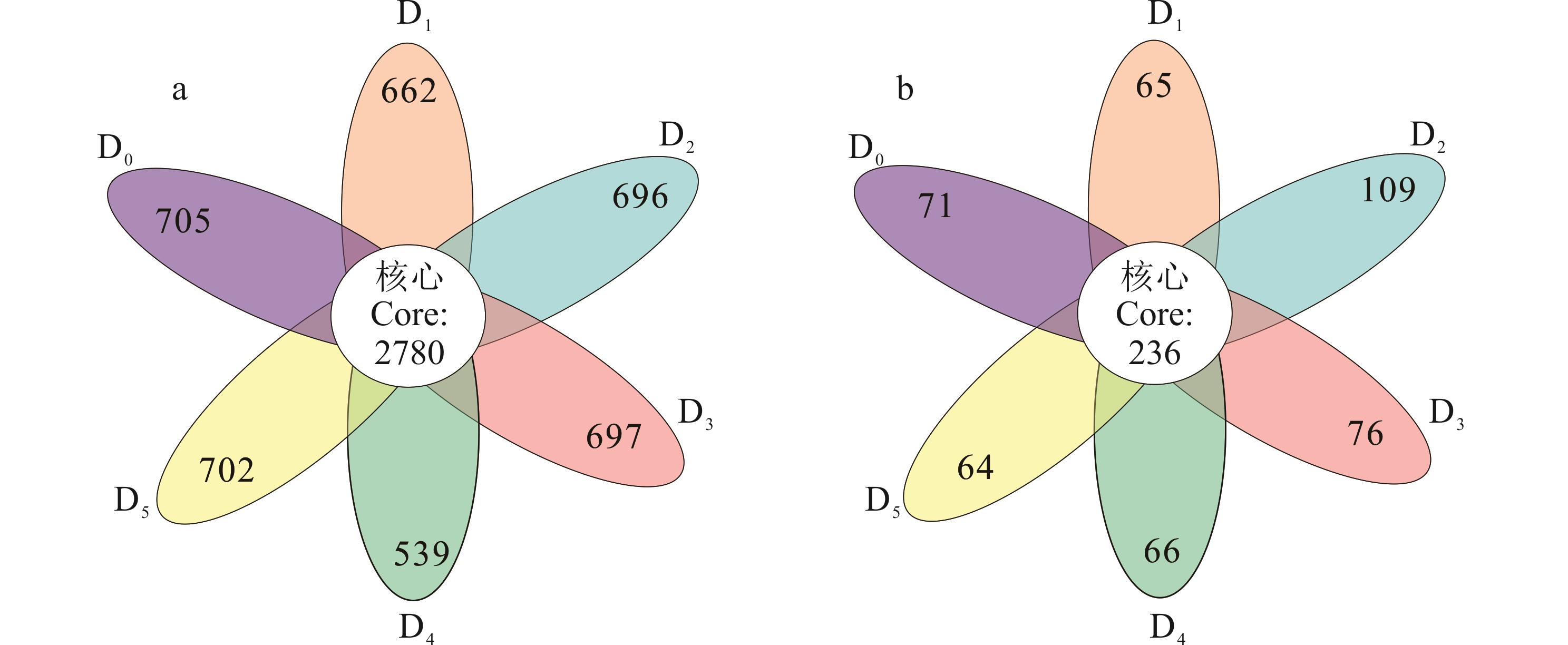
Fig. 1 The OTUs Venn analysis of soil bacteria (a) and fungi (b) under different density patches of L. virgaurea
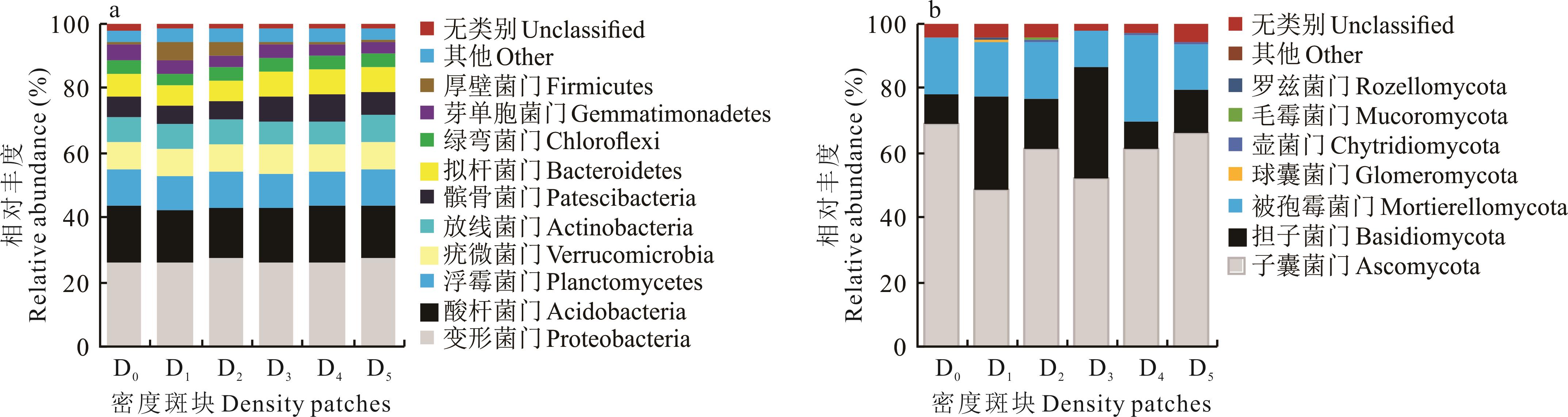
Fig. 2 Soil bacteria (a) and fungi (b) species composition of phylum level in different density patches of L. virgaurea
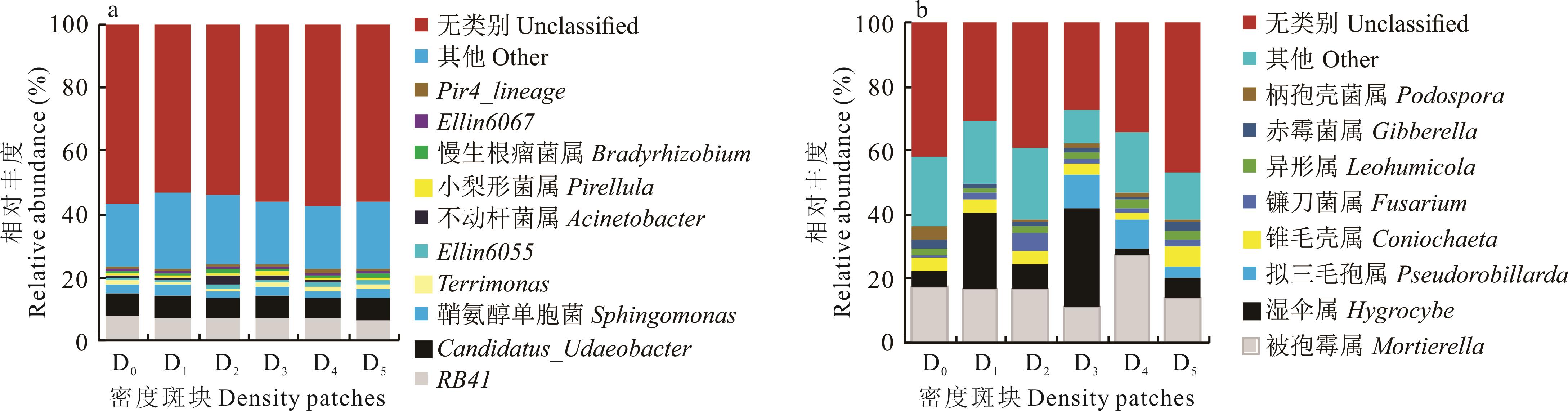
Fig. 3 Soil bacteria (a) and fungi (b) species composition of genus level in different density patches of L. virgaurea
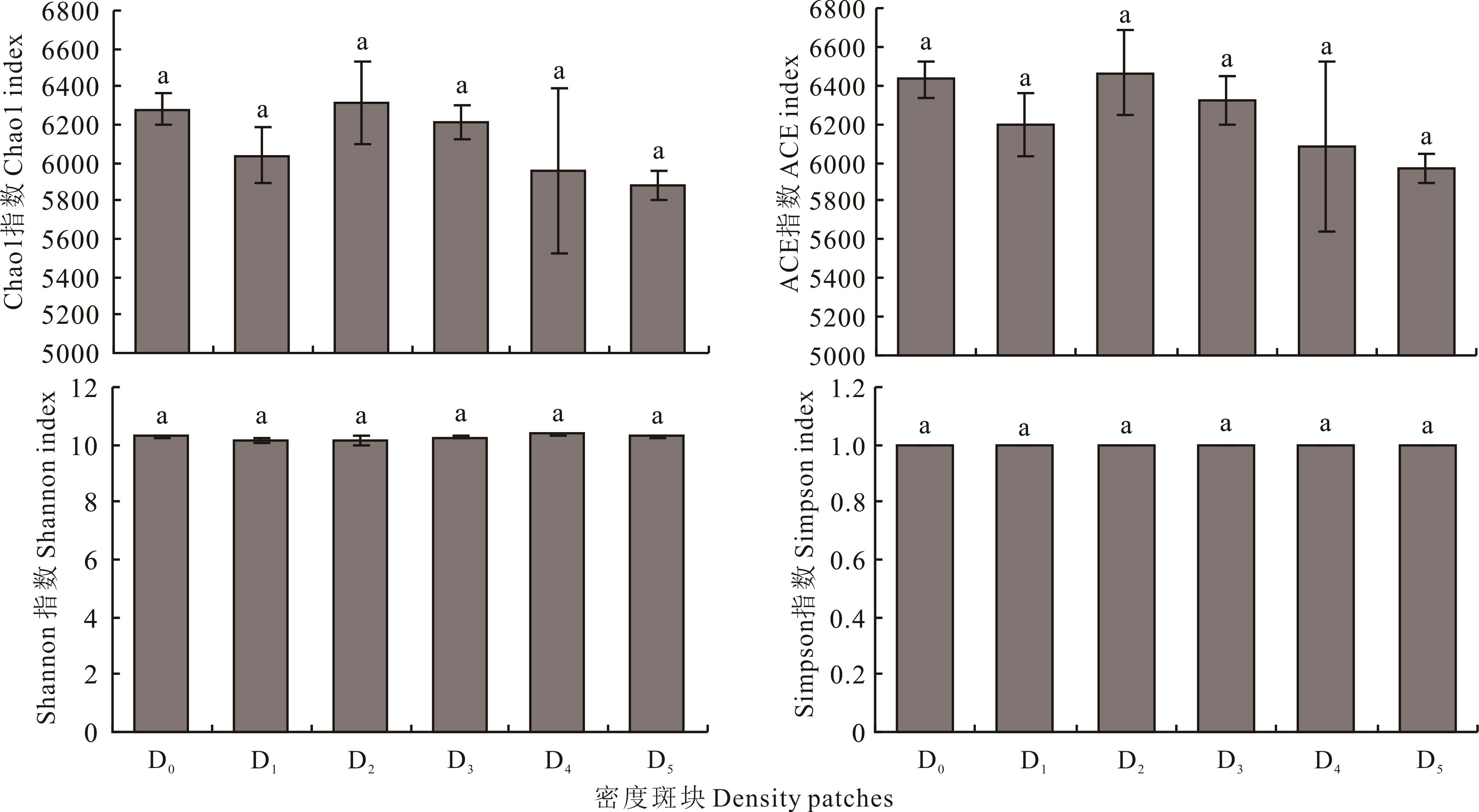
Fig. 4 α-diversity of soil bacterial communities in different density patches of L. virgaurea
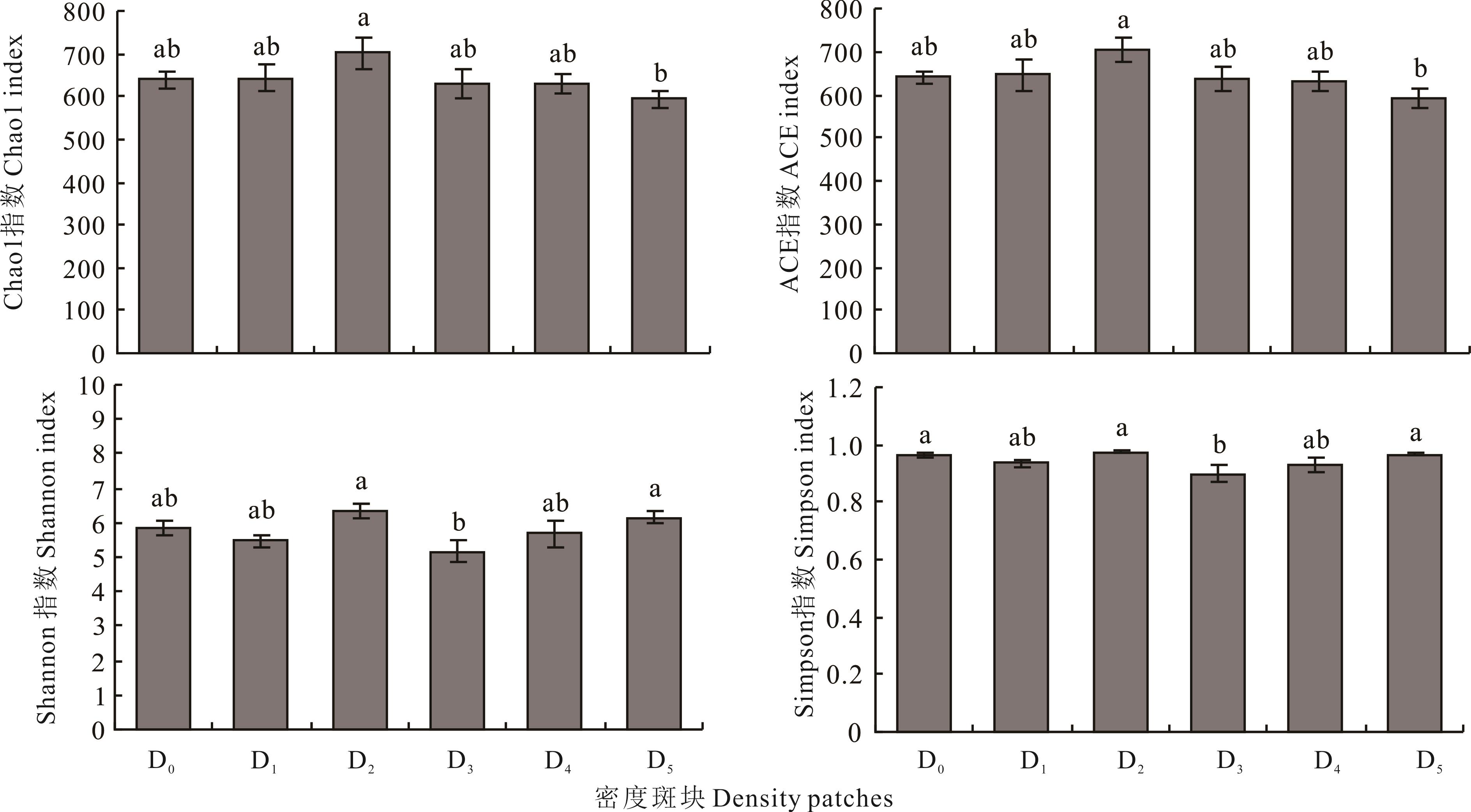
Fig. 5 α-diversity of soil fungal communities in different density patches of L. virgaurea
指标 Index | 微生物 Microorganism | Shannon指数 Shannon index | Simpson指数 Simpson index | ACE指数 ACE index | Chaol指数 Chaol index |
|---|---|---|---|---|---|
黄帚橐吾密度 Density of L. virgaurea | 细菌 Bacteria | 0.251 | 0.282 | -0.362* | -0.321 |
| 真菌 Fungi | 0.197 | 0.096 | -0.403* | -0.359* |
Table 2 Correlation coefficients between L. virgaurea density and microbial diversity
指标 Index | 微生物 Microorganism | Shannon指数 Shannon index | Simpson指数 Simpson index | ACE指数 ACE index | Chaol指数 Chaol index |
|---|---|---|---|---|---|
黄帚橐吾密度 Density of L. virgaurea | 细菌 Bacteria | 0.251 | 0.282 | -0.362* | -0.321 |
| 真菌 Fungi | 0.197 | 0.096 | -0.403* | -0.359* |
| 1 | Bennett J A, Maherali H, Reinhart K O, et al. Plant-soil feedbacks and mycorrhizal type influence temperate forest population dynamics. Science, 2017, 355(6321): 181-184. |
| 2 | Boerner R E, Coates A T, Yaussy D A, et al. Assessing ecosystem restoration alternatives in eastern deciduous forests: the view from belowground. Restoration Ecology, 2008, 16(3): 425-434. |
| 3 | Harris J. Soil microbial communities and restoration ecology: facilitators or followers? Science, 2009, 325(5940): 573-574. |
| 4 | Liu J J, Li J H, Ji Y, et al. Relationship between soil microbial community composition and soil physicochemical properties in riparian zone of Huihe wetland. Acta Agrestia Sinica, 2023, 31(5): 1393-1405. |
| 刘晶晶, 李金花, 季燕, 等. 辉河湿地河岸带土壤微生物群落组成与土壤理化关系. 草地学报, 2023, 31(5): 1393-1405. | |
| 5 | Leff J W, Bardgett R D, Wilkinson A, et al. Predicting the structure of soil communities from plant community taxonomy, phylogeny, and traits. The ISME Journal, 2018, 12(7): 1794-1805. |
| 6 | Wardle D A, Bardgett R D, Klironomos J N, et al. Ecological linkages between aboveground and belowground biota. Science, 2004, 304(5677): 1629-1633. |
| 7 | Bao H Y, Li Y, Deng X Z, et al. Effects of different root exudates and plant litter input on soil microbial enzyme activities and residues in alpine desertified grassland. Chinese Journal of Applied and Environmental Biology, 2023, 29(1): 1-10. |
| 包寒阳, 李杨, 邓先智, 等. 根系分泌物和凋落物对高寒沙化草地土壤微生物的影响. 应用与环境生物学报, 2023, 29(1): 1-10. | |
| 8 | Niu Q M, Shan G L, Luo Q, et al. Effect of invasion and diffusion of poisonous weeds on soil microbial diversity in subalpine meadow in northwest Yunnan. Acta Agrestia Sinica, 2023, 31(7): 1996-2004. |
| 牛琼梅, 单贵莲, 罗钦, 等. 毒害草入侵扩散对滇西北亚高山草甸土壤微生物多样性的影响. 草地学报, 2023, 31(7): 1996-2004. | |
| 9 | Wang Y Q, Song M L, Zhou R, et al. Characteristics of plant community structure of different Ligularia virgaurea density patches in alpine meadow. Acta Agrestia Sinica, 2022, 30(9): 2264-2272. |
| 王玉琴, 宋梅玲, 周睿, 等. 高寒草甸不同黄帚橐吾密度斑块的植物群落结构特征. 草地学报, 2022, 30(9): 2264-2272. | |
| 10 | Xiao L, Liu G B, Li P, et al. Ecoenzymatic stoichiometry and microbial nutrient limitation during secondary succession of natural grassland on the Loess Plateau, China. Soil and Tillage Research, 2020, 200: 104605. |
| 11 | Ai M H. The effects and mechanism of noxious weed Ligularia virgaurea removal on soil microbial community in Qinghai-Tibet Plateau. Lanzhou: Lanzhou University, 2022. |
| 艾梦涵. 青藏高原毒杂草黄帚橐吾移除对土壤微生物群落的影响及机制研究. 兰州: 兰州大学, 2022. | |
| 12 | Ade L, Millner J P, Hou F J. The dominance of Ligularia spp. related to significant changes in soil microenvironment. Ecological Indicators, 2021, 131: 108183. |
| 13 | Shi G X, Wang W Y, Jiang S J, et al. Effects of the spreading of Ligularia virgaurea on soil physicochemical property and microbial functional diversity. Chinese Journal of Plant Ecology, 2018, 42(1): 126-132. |
| 石国玺, 王文颖, 蒋胜竞, 等. 黄帚橐吾种群扩张对土壤理化特性与微生物功能多样性的影响. 植物生态学报, 2018, 42(1): 126-132. | |
| 14 | Shi X M, Li X G, Wu R M, et al. Changes in soil biochemical properties associated with Ligularia virgaurea spreading in grazed alpine meadows. Plant and Soil, 2011, 347(1/2): 65-78. |
| 15 | Marler M J, Zabinski C A, Callaway R M. Mycorrhizae indirectly enhance competitive effects of an invasive forb on a native bunchgrass. Ecology, 1999, 80(4): 1180-1186. |
| 16 | Mou D, Zhang S B, Ou W Y, et al. Prospects for replacement control for native invader Ligularia virgaurea. Journal of Biosafety, 2020, 29(4): 235-241. |
| 牟丹, 张世彬, 欧为友, 等. 土著入侵种黄帚橐吾的替代防控展望. 生物安全学报, 2020, 29(4): 235-241. | |
| 17 | Peng X Y, Li Y C, Wang X L, et al. Effects of invasive plants on soil microbial communities: a review. Journal of Zhejiang A&F University, 2019, 36(5): 1019-1027. |
| 彭鑫怡, 李永春, 王秀玲, 等. 植物入侵对土壤微生物的影响. 浙江农林大学学报, 2019, 36(5): 1019-1027. | |
| 18 | Li B, Li Y Y. The interaction between invasive and native species in the biological invasion. Sichuan Environment, 2009, 28(1): 64-67. |
| 李冰, 李玉瑛. 生物入侵中入侵种与土著种的相互作用. 四川环境, 2009, 28(1): 64-67. | |
| 19 | Xie T P, Zhang G F, Zhao Z G, et al. Intraspecific competition and light effect on reproduction of Ligularia virgaurea, an invasive native alpine grassland clonal herb. Ecology and Evolution, 2014, 4(6): 817-825. |
| 20 | Qinghai Province grassland station. Technical specification for comprehensive treatment of toxic grass in grassland, DB63/T 241-2021. Market Supervision Administration of Qinghai Province, 2021. |
| 青海省草原总站. 草地毒害草综合治理技术规范, , DB63/T 241-2021. 青海省市场监督管理局, 2021. | |
| 21 | Walters W A, Jin Z, Youngblut N, et al. Large-scale replicated field study of maize rhizosphere identifies heritable microbes. Proceedings of the National Academy of Sciences of the United States of America, 2018, 115(28): 7368-7373. |
| 22 | Orlando J, Alfaro M, Bravo L, et al. Bacterial diversity and occurrence of ammonia-oxidizing bacteria in the Atacama desert soil during a “desert bloom” event. Soil Biology & Biochemistry, 2010, 42(7): 1183-1188. |
| 23 | Zhang X F, Zhao L, Liu Y Z, et al. Soil moisture effect on bacterial and fungal community in Beilu River (Tibetan Plateau) permafrost soils with different vegetation types. Journal of Applied Microbiology, 2013, 114(4): 1054-1065. |
| 24 | Zhang X L, Sun X Y, An B S, et al. Soil microbial community structure in different ecosystem types of the Lhasa River Basin. Chinese Journal of Ecology, 2024, 43(6): 1728-1737. |
| 张晓黎, 孙向阳, 安宝晟, 等. 拉萨河流域不同生态系统类型土壤微生物群落结构特征.生态学杂志, 2024, 43(6): 1728-1737. | |
| 25 | Wang Z Q, Zhang J X, Yang X L, et al. Characteristics of soil microbial diversity in different patches of alpine meadow. Acta Agrestia Sinica, 2021, 29(9): 1916-1926. |
| 王占青, 张杰雪, 杨雪莲, 等. 高寒草甸不同斑块草地土壤微生物多样性特征研究. 草地学报, 2021, 29(9): 1916-1926. | |
| 26 | Zhou T Q, Kong W D, Chen H. Research progress of grassland soil microorganisms in Qinghai-Tibet Plateau. Chinese Journal of Ecology, 2023, 42(4): 983-990. |
| 周天祺, 孔维栋, 陈昊. 青藏高原草地土壤微生物研究进展. 生态学杂志, 2023, 42(4): 983-990. | |
| 27 | Kersters K, de Vos P, Gillis M, et al. Introduction to the Proteobacteria//The prokaryotes, New York: Springer, 2006: 3-37. |
| 28 | Fierer N, Bradford M A, Jackson R B. Toward an ecological classification of soil bacteria. Ecology, 2007, 88(6): 1354-1364. |
| 29 | Stone B W, Li J H, Koch B J, et al. Nutrients cause consolidation of soil carbon flux to small proportion of bacterial community. Nature Communications, 2021, 12: 3381. |
| 30 | Kalam S, Basu A, Ahmad I, et al. Recent understanding of soil Acidobacteria and their ecological significance: A critical review. Frontiers in Microbiology, 2020, 11: 580024. |
| 31 | Xiao Y, Huang Z G, Li Y F, et al. Soil microbial community structure and diversity of typical vegetation types in Chishui River Basin. Research of Soil and Water Conservation, 2022, 29(6): 275-283. |
| 肖烨, 黄志刚, 李友凤, 等. 赤水河流域典型植被类型的土壤微生物群落结构与多样性. 水土保持研究, 2022, 29(6): 275-283. | |
| 32 | She T, Tian Y. Effects of litter diversity on decomposition process and soil microbial characteristics in forest ecosystems.Ecological Science, 2020, 39(1): 213-223. |
| 佘婷, 田野. 森林生态系统凋落物多样性对分解过程和土壤微生物特性影响研究进展. 生态科学, 2020, 39(1): 213-223. | |
| 33 | Wang Y F, Wei S P, Cui H P, et al. Distribution and diversity of microbial community along a vertical permafrost profile, Qinghai-Tibetan Plateau. Microbiology China, 2016, 43(9): 1902-1917. |
| 王艳发, 魏士平, 崔鸿鹏, 等. 青藏高原冻土区土壤垂直剖面中微生物的分布与多样性. 微生物学通报, 2016, 43(9): 1902-1917. | |
| 34 | Yan P, Du Y D, Jiang A X, et al. Response of soil fungal community structures and interaction networks to salinity in the Yellow River Delta. Molecular Plant Breeding, 2021, 19(11): 3818-3828. |
| 颜培, 杜远达, 姜爱霞, 等. 黄河三角洲土壤真菌群落结构及互作网络对盐度的响应. 分子植物育种, 2021, 19(11): 3818-3828. | |
| 35 | de Araujo A S F, Bezerra W M, dos Santos V M, et al. Fungal diversity in soils across a gradient of preserved Brazilian Cerrado. Journal of Microbiology, 2017, 55(4): 273-279. |
| 36 | Geng D Z, Huang J H, Huo N, et al. Characteristics of soil microbial and nematode communities under artificial Medicago sativa grasslands with different cultivation years in semi-arid region of Loess Plateau, Northwest China. Chinese Journal of Applied Ecology, 2020, 31(4): 1365-1377. |
| 耿德洲, 黄菁华, 霍娜, 等. 黄土高原半干旱区不同种植年限紫花苜蓿人工草地土壤微生物和线虫群落特征. 应用生态学报, 2020, 31(4): 1365-1377. | |
| 37 | Beimforde C, Feldberg K, Nylinder S, et al. Estimating the Phanerozoic history of the Ascomycota lineages: Combining fossil and molecular data. Molecular Phylogenetics and Evolution, 2014, 78: 386-398. |
| 38 | Frey S D, Knorr M, Parrent J L, et al. Chronic nitrogen enrichment affects the structure and function of the soil microbial community in temperate hardwood and pine forests. Forest Ecology and Management, 2004, 196(1): 159-171. |
| 39 | Curran H J, Fischer S L, Dryer F L. The reaction kinetics of dimethyl ether. Ⅱ: Low-temperature oxidation in flow reactors. International Journal of Chemical Kinetics, 2000, 32: 741-759. |
| 40 | Ning Q, Chen L, Li F, et al. Effects of Mortierella on nutient availability and straw decomposition in soil.Acta Pedologica Sinica, 2022, 59(1): 206-217. |
| 宁琪, 陈林, 李芳, 等. 被孢霉对土壤养分有效性和秸秆降解的影响. 土壤学报, 2022, 59(1): 206-217. | |
| 41 | Osorio N W, Habte M. Soil phosphate desorption induced by a phosphate-solubilizing fungus. Communications in Soil Science and Plant Analysis, 2014, 45(4): 451-460. |
| 42 | Yin Y L. Study on soil-microorganism interation in degraded alpine meadow at the three-river source region. Xining: Qinhai University, 2020. |
| 尹亚丽. 三江源区退化高寒草甸土壤-微生物互作研究. 西宁: 青海大学, 2020. | |
| 43 | Callaway R M, Cipollini D, Barto K, et al. Novel weapons: Invasive plant suppresses fungal mutualists in America but not in its native Europe. Ecology, 2008, 89(4): 1043-1055. |
| 44 | Wu Y, Chen D, Saleem M, et al. Rare soil microbial taxa regulate the negative effects of land degradation drivers on soil organic matter decomposition. Journal of Applied Ecology, 2021, 58(8): 1658-1669. |
| 45 | Li F, Liu Z H, Jia T H, et al. Functional diversity of soil microbial community carbon metabolism with the degradation and restoration of alpine wetlands and meadows. Acta Ecologica Sinica, 2018, 38(17): 6006-6015. |
| 李飞, 刘振恒, 贾甜华, 等. 高寒湿地和草甸退化及恢复对土壤微生物碳代谢功能多样性的影响. 生态学报, 2018, 38(17): 6006-6015. |
| [1] | Shou-xing WANG, Hua-kun ZHOU, Li-peng OU, Cheng-xian LI, Yan-he WANG, Xiao-chun NING, Qiang GU, Dai-jun WEI, Ming-xin YANG. Vegetation and soil microbial diversity and their relationships with soil factors in different grassland types of the three river headwaters region [J]. Acta Prataculturae Sinica, 2025, 34(4): 16-26. |
| [2] | Xin-you WANG, Xiao-lan WANG, Wan-chang ZHANG, Ying LI, Yong-ling MA, Xiao-yin WANG, Jian-gang WANG, Hai-qing WANG, Bei-fan YUE, Yong-fu LIU, Yong-hong WANG, Shan LIU, Mei-ting BAI. Selection of optimal varieties of silage maize and methods for cultivation in mountainous forest-margin areas of southeast Gansu Province [J]. Acta Prataculturae Sinica, 2025, 34(1): 191-202. |
| [3] | Yuan-fei MA, Yan-tao SONG, Yun-na WU, Cheng-feng FANG. Effects of fertilization and mowing for 5 years on soil microbial characteristics in Hulunbuir meadow steppe [J]. Acta Prataculturae Sinica, 2024, 33(9): 242-251. |
| [4] | Shuang LIU, Jia-ni YAO, Jun-jie ZHANG, Jin-xia DAI. Functional gene abundance and community diversity of ammonia-oxidizing and denitrifying microorganisms in the rhizosphere soil of desert leguminous shrubs [J]. Acta Prataculturae Sinica, 2024, 33(5): 115-127. |
| [5] | Chen-yang ZHANG, Meng-jun JIN, Yong-feng XU, Cheng-de YANG. Effects of maize continuous cropping on soil microbial community structure based on metagenomic analysis [J]. Acta Prataculturae Sinica, 2024, 33(12): 160-174. |
| [6] | Ao JIANG, Lu-huai JING, Tserang-donko MIPAM, Li-ming TIAN. Progress in research on the effects of grazing on grassland litter decomposition [J]. Acta Prataculturae Sinica, 2023, 32(4): 208-220. |
| [7] | Wei-jie LI, Li WANG, Jing-yong MA, Zi-kui WANG. Effects of a cover crop on deep soil water and root characteristics in a dryland apple orchard on the Loess Plateau [J]. Acta Prataculturae Sinica, 2023, 32(1): 63-74. |
| [8] | Da-liang ZHOU, Wei SHI, Zi-wei JIANG, Zheng-ye WEI, Huan-huan LIANG, Qian-min JIA. Effects of planting density and nitrogen application on leaf enzyme activity and water-nitrogen utilization of silage maize under ridge furrow rainwater harvesting in Loess Plateau [J]. Acta Prataculturae Sinica, 2022, 31(8): 126-143. |
| [9] | Zi-wei JIANG, Gui-yu LIU, Hao-yun AN, Wei SHI, Sheng-hua CHANG, Cheng ZHANG, Qian-min JIA, Fu-jiang HOU. Effects of planting density and nitrogen application on forage yield, quality and nitrogen use efficiency in a maize/forage soybean intercropping system [J]. Acta Prataculturae Sinica, 2022, 31(7): 157-171. |
| [10] | Xiao-min FAN, Xin JING, Bo-wen XIAO, Xiao-liang MA, Jin-sheng HE. Climate and land-use change jointly determine the spatial-temporal changes of ecosystem services in Hainan and Haibei Tibetan Autonomous Prefectures, Qinghai Province [J]. Acta Prataculturae Sinica, 2022, 31(12): 17-30. |
| [11] | Yu-qin WANG, Mei-ling SONG, Rui ZHOU, Hong-sheng WANG, Hua LIU, Xiu-lian ZHU, Yu-shou MA. Effects of Ligularia virgaurea on plant and soil nutrient levels and soil microbial biomass characteristics in degraded alpine grassland [J]. Acta Prataculturae Sinica, 2022, 31(12): 31-40. |
| [12] | Chun-wen WANG, Fang ZHAO, Chen ZHANG, Li-na XIE, Cheng-cang MA. Effects of Caragana microphylla shrubs on the soil nitrogen-fixing microbial communities in steppe land [J]. Acta Prataculturae Sinica, 2022, 31(10): 28-40. |
| [13] | Hua-fang SUN, Xi-lai LI, Li-qun JIN, Cheng-yi LI, Jing ZHANG. Change over time in soil microbial diversity of artificial grassland in the Yellow River source zone [J]. Acta Prataculturae Sinica, 2021, 30(2): 46-58. |
| [14] | Da-cheng SONG, Li-de WANG, Hao WU, Chun-rong WU, He-ran ZHAO, Sheng-hui HAN, Bao-yi XU. A study of change in soil characteristics with recovery time in degraded grassland in Minqin [J]. Acta Prataculturae Sinica, 2021, 30(2): 59-68. |
| [15] | Guo-bao HE. Distribution characteristics and plant community diversity on the north slopes of the Qilian Mountains [J]. Acta Prataculturae Sinica, 2021, 30(12): 194-201. |
| Viewed | ||||||
|
Full text |
|
|||||
|
Abstract |
|
|||||
